
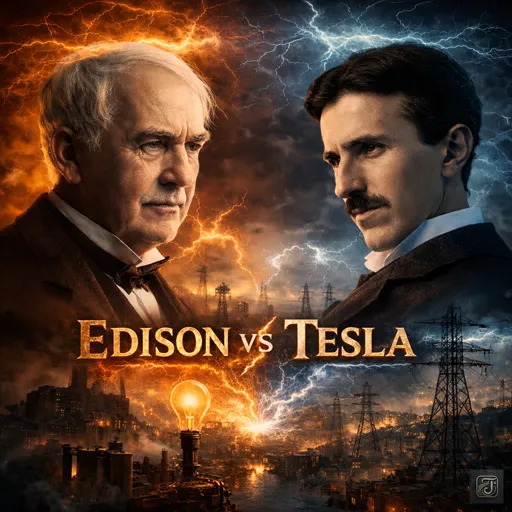
⚡ Edison vs Tesla (A Quick Overview)
Thomas Edison
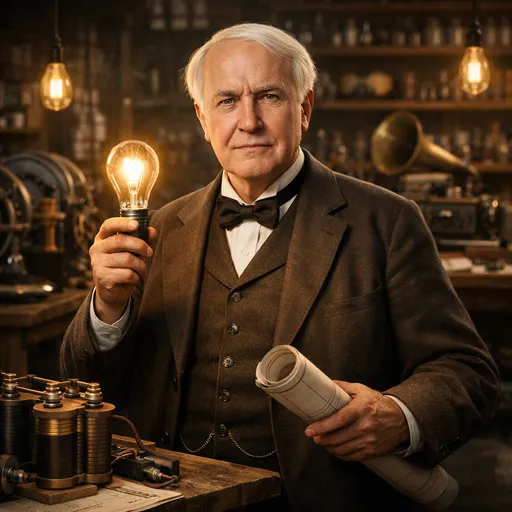
- An entrepreneur-style inventor
- A genius at creating systems that sell
- Advocated direct current (DC)👉 In short:
“The man who controlled reality”
Nikola Tesla
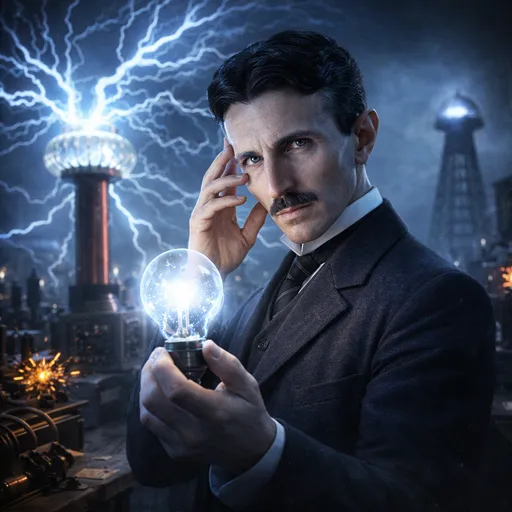
- An exceptionally brilliant theorist
- Vision-driven
- Advocated alternating current (AC)👉 In short:
“The man who saw the future”
⚔️ The War of Currents
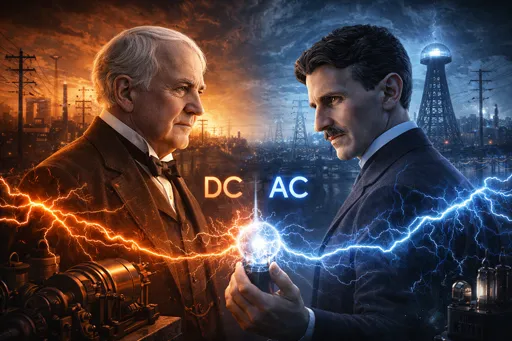
Key issue: How should electricity be transmitted?
Edison → Direct Current (DC)
- Strong over short distances
- But cannot travel far
- Requires many power stations
Tesla → Alternating Current (AC)
- Voltage can be transformed (this was revolutionary)
- Capable of long-distance transmission
- The foundation of modern power grids
👉 Conclusion
Tesla’s alternating current (AC) won
(Almost all the electricity in your home today is AC)
🧠 The fundamental differences between the two
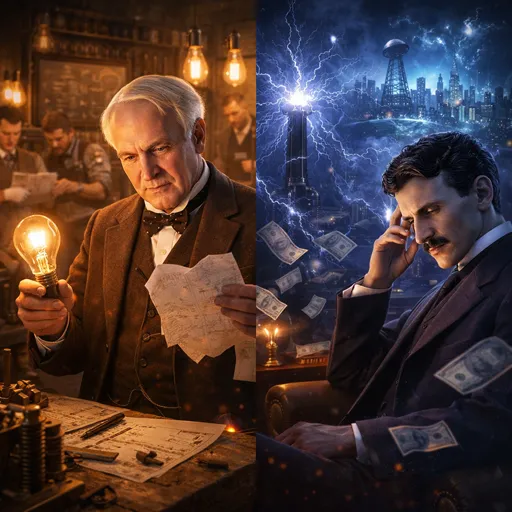
Edison
- Keeps going even after 1,000 failures
- Develops with a team
- Focuses on patents and business
👉 “The power to move reality.”
Tesla
- Completes inventions in his mind
- A solitary genius
- Indifferent to money
👉 “The power to get ahead of the future.”
💥 Famous Rivalry Episodes
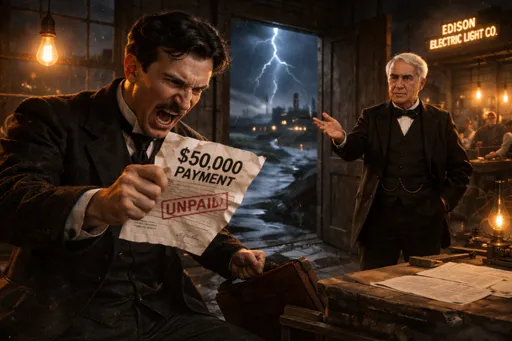
① Tesla was once Edison’s employee
- The promised payment → never delivered
- Tesla, furious, quit
👉 This is where they completely broke apart
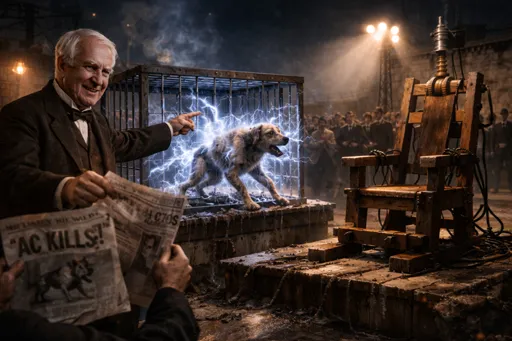
② Edison’s smear campaign
To undermine AC…
- He electrocuted animals to promote the idea that “AC is dangerous.”
- He pushed for AC to be used in the electric chair (executions)
👉 Honestly, it was pretty brutal
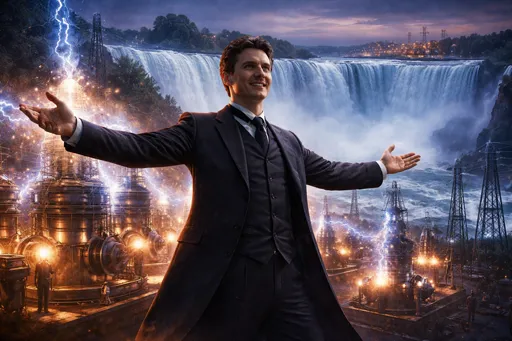
③ Tesla’s comeback
- Successfully generated power at Niagara Falls
- Proved to the world that AC was the right choice
👉 This is where the outcome was decided
🏁 Their Final Years
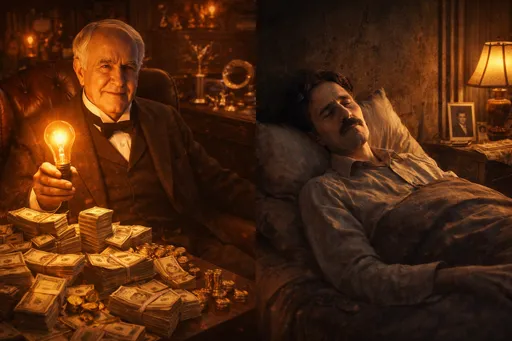
Edison
- Vast wealth
- Fame
- Died as a “successful man.”
Tesla
- Poverty
- Loneliness
- Died quietly in a hotel
👉 However, today he is being widely re-evaluated
🧨 Interesting Facts
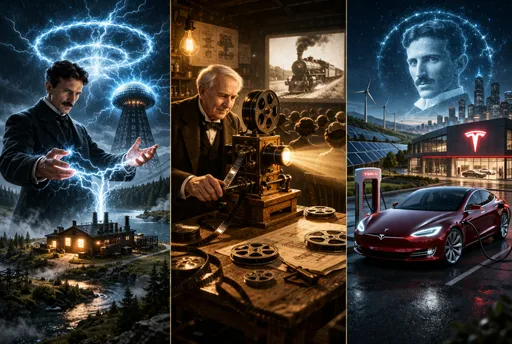
- Tesla seriously attempted wireless power transmission
- Edison also laid the foundations of motion pictures
- Tesla’s name → the origin of the electric vehicle company Tesla, Inc.
🎯 Conclusion
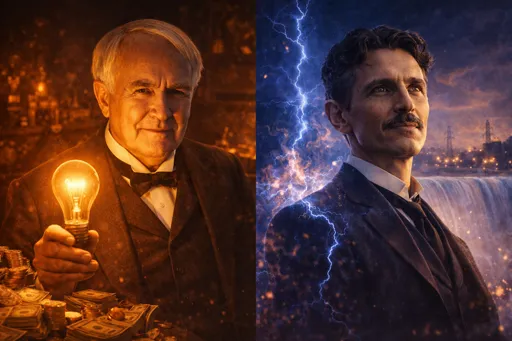
- Edison → The man who won
- Tesla → The man who was right
The story of Edison vs. Tesla — The Full Story of the War of Currents begins here.
Prologue: The Age of Darkness
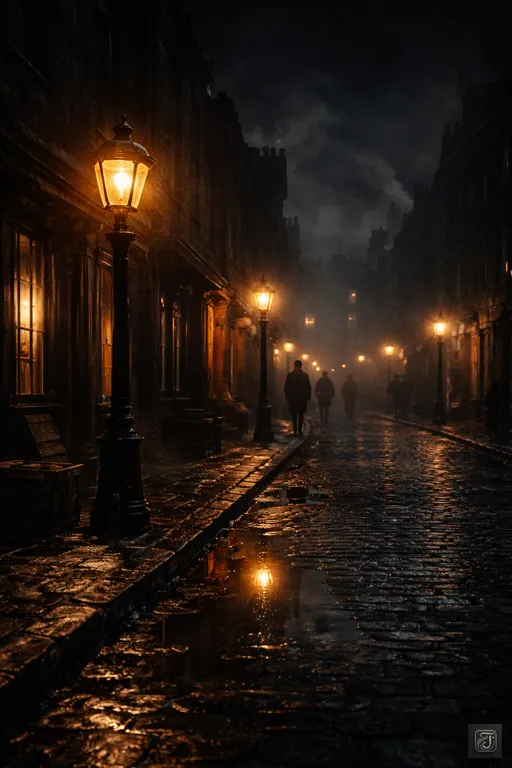
The Age of Darkness
The night was not completely dark.
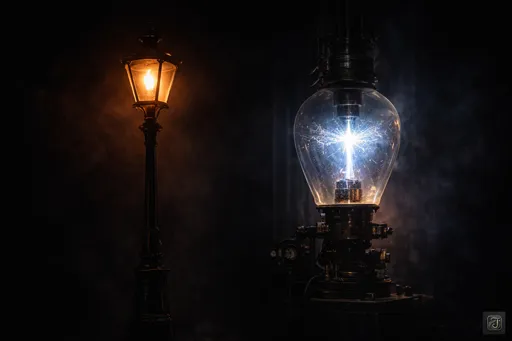
Along the streets, rows of gas lamps exhaled a yellow, murky glow.
That light trembled.
It swayed in the wind, yielded easily to rain, and vanished with the slightest malfunction.
Beneath it, shadows warped, and faces were only half revealed.
The city at night was always heavy with unease.
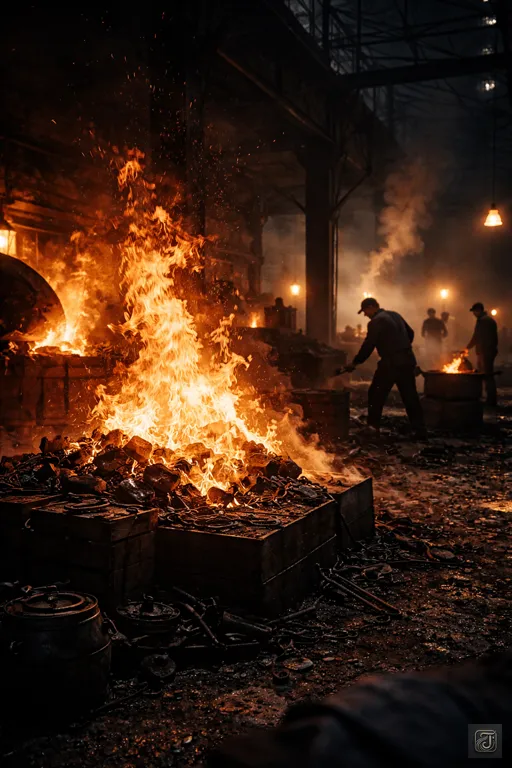
Yet even at the end of the nineteenth century, people had not fully let go of it.
Light was meant to be a symbol of progress—
and at the same time, something that could explode, spread uncontrollably, and take lives.
Humanity feared light.
And yet, humanity longed for it.
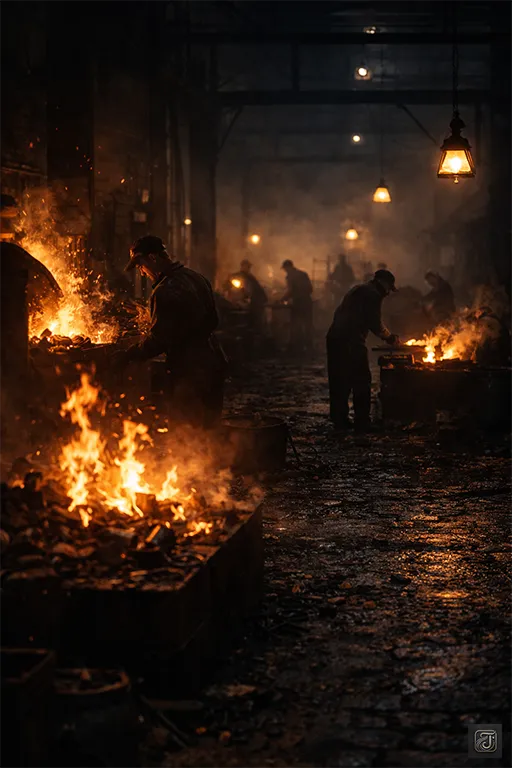
Those who labored near open flames never knew when their clothes might catch fire.
In the cities, accidents caused by gas leaks were endless.
Light was convenient—but it was not safe.
Still, people wanted to drive the night away.
If darkness vanished, working hours would stretch longer, cities would expand, and the world would accelerate.
Light was supposed to create wealth, grant power, and promise the future.
But light had more than one path.
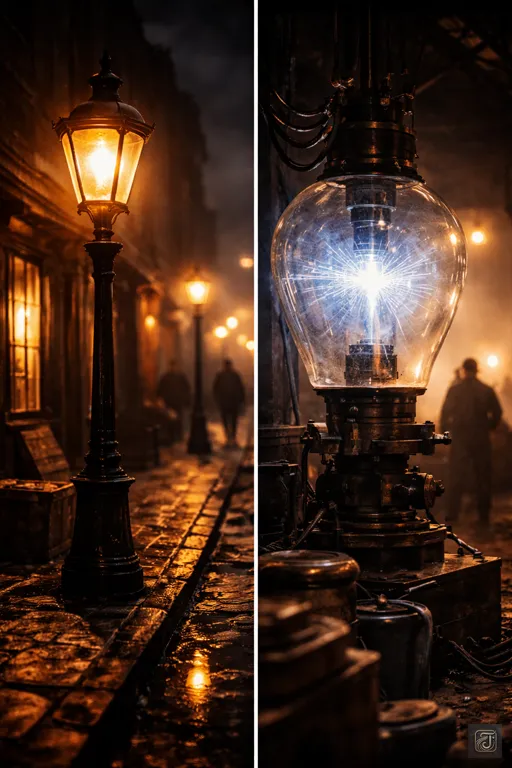
But it could not reach far.
Another possessed power that was too great—
and if handled carelessly, it could even kill.
People did not yet know.
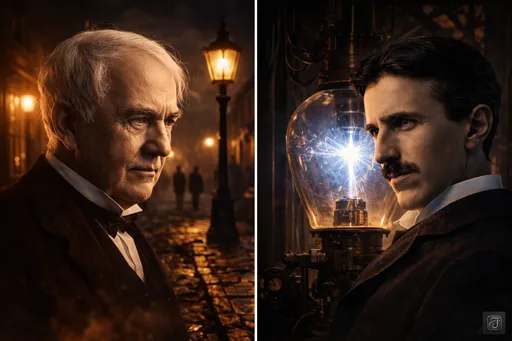
That what was about to arrive was not merely a technological revolution,
but a collision of ideas.
Which light would be chosen?
Safety, or efficiency.
The present, or the future.
Profit, or humanity.
That choice would not be made in some forgotten corner of the city.
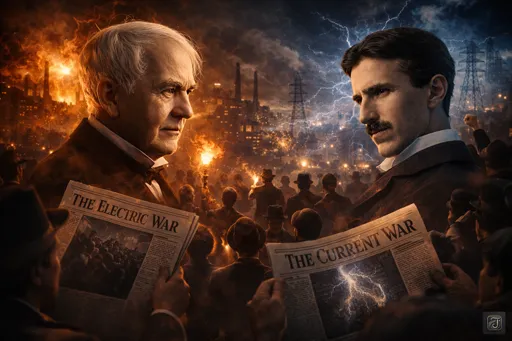
It would be decided by newspaper headlines,
by the judgments of investors,
by the fears of the crowd,
and by the convictions of a very small number of individuals.
In time, the world would be completely illuminated at night.
Yet people would forget whose hands created that light,
What was sacrificed to bring it forth,
and upon which values it was built.
Before this story can speak of two men whose names were not yet known,
It must first speak of light itself.
Because—
Light is not neutral.
How it is used determines the shape of civilization.
Humanity stood at a crossroads.
What kind of light would it choose?
In the darkness,
That question alone glowed quietly.
Chapter 1: The Boy Struck by Lightning
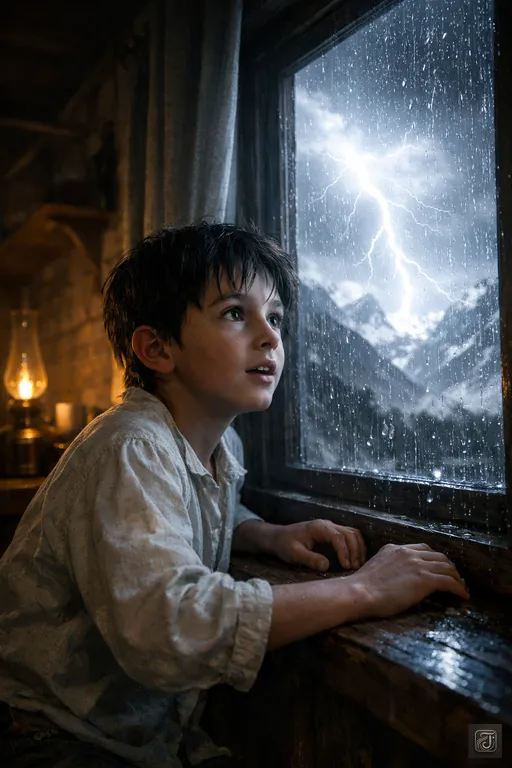
It was a stormy night.
The sky split open, lightning exploding again and again above the mountains.
Rain fell hard, the sound of it striking the windows repeating with steady rhythm.
It was the kind of night when people hid deep inside their homes, waiting for the darkness to pass as if in prayer.
Inside one such house, only a single boy kept his eyes wide open.
The instant lightning struck, the world turned white for a heartbeat.
At that flash of light, the boy did not feel fear.
Instead—something deep in his chest pulsed, hard and alive.
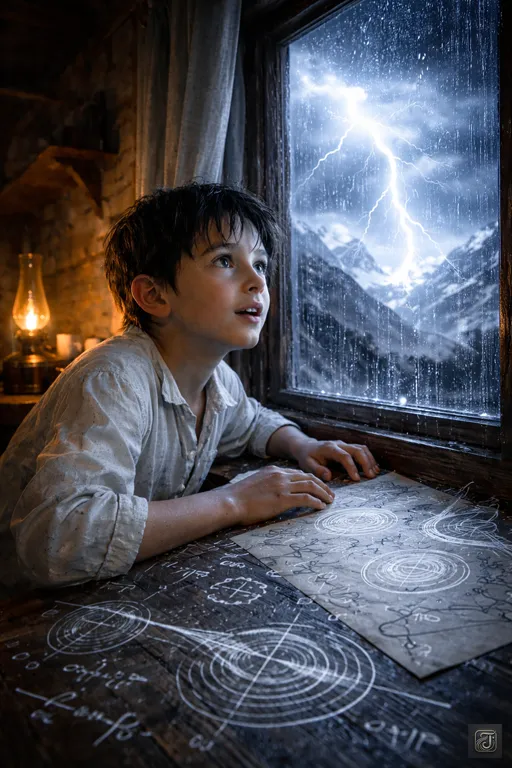
His name was Nikola Tesla.
To him, lightning was not something to fear.
It was a question.
Why does light tear through the sky?
Why does the flash arrive before the sound?
Why does such immense power vanish in an instant?
In the boy’s mind, light did not exist as a mere phenomenon,
but as a structure.
Each time thunder roared, lines were drawn in his thoughts,
circles began to turn, and currents were born.
Tesla closed his eyes.
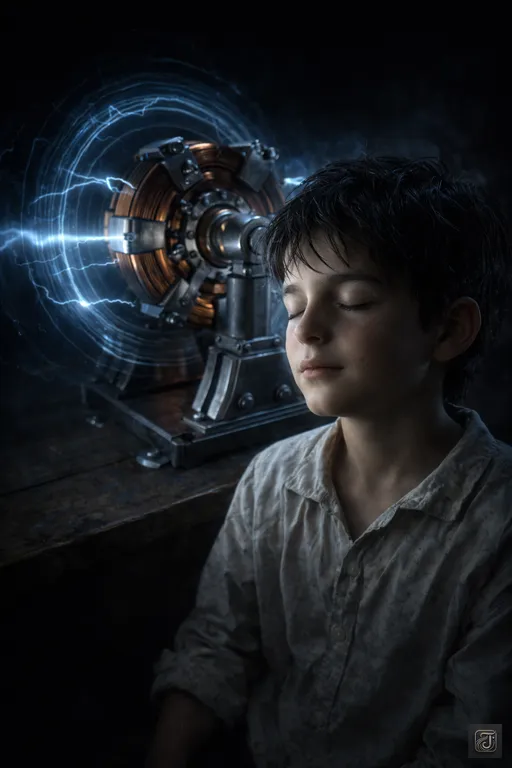
In the darkness, a machine begins to move.
A rotating magnetic field.
Invisible currents, alternating as they give strength to one another.
No sparks. No smoke.
Only power, turning in silence.It was a machine no one had yet built.
No—before it was ever built, it was already complete within him.Tesla would later say:
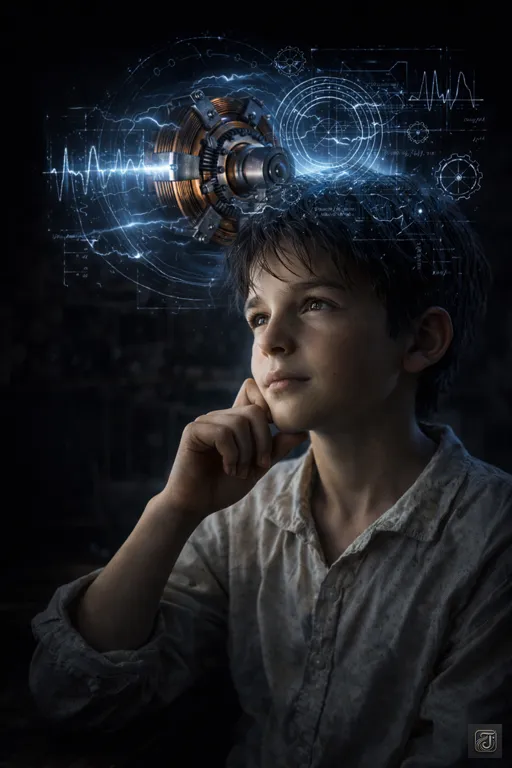
Invention, he believed, was not born from trial and error.
It appeared from the beginning in a perfect form.
For him, experiments in the real world were nothing more than verification.
The blueprint existed not on paper, but in his mind.
The boy was alone.
Those around him mistook his silence for shyness and dismissed his piercing gaze as mere daydreaming.
But Tesla was not fantasizing.
He was seeing the future.
By day, he read books.
By night, he thought.
While others slept, the gears in his mind continued to turn.
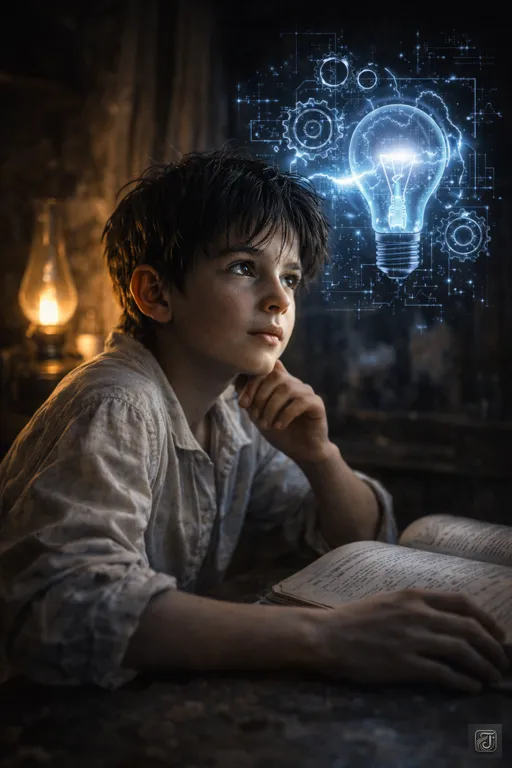
Nor does it need to be something that merely crawls along a wire.
Handled correctly, it should be able to travel far without harming the world.”
That was his conviction.
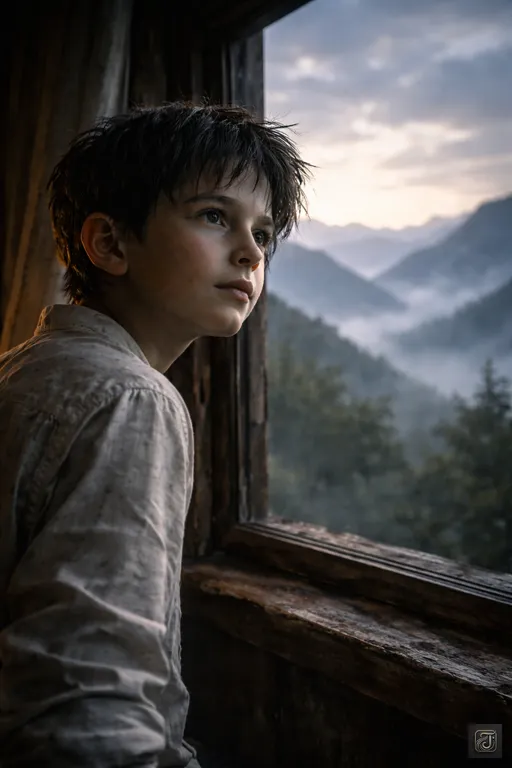
The storm passed with the coming of dawn.
Mist lingered over the mountains, and the air was clear.
But within the boy, the storm had not ended.
The lightning had struck him—
not his body,
but his thoughts.
From that night on, Tesla knew.
He knew that he would not walk an ordinary life.
Light had chosen him.
And he would spend his entire life trying to set that light free.
No one yet knew
that this boy would one day change the world’s nights.
And at the same time—
that as the price for it,
he would take upon himself a profound solitude.
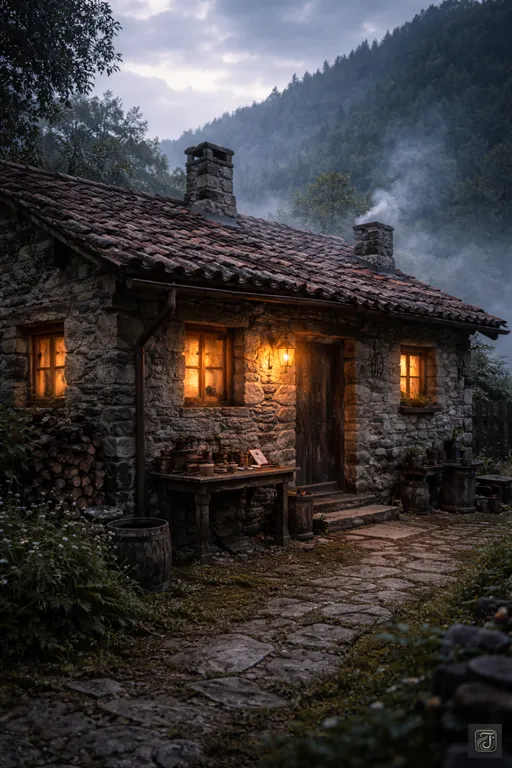
Tesla’s home was modest.
A stone house in a mountain village.
There was nothing special about it.
And yet,
A strange air lingered within its walls.
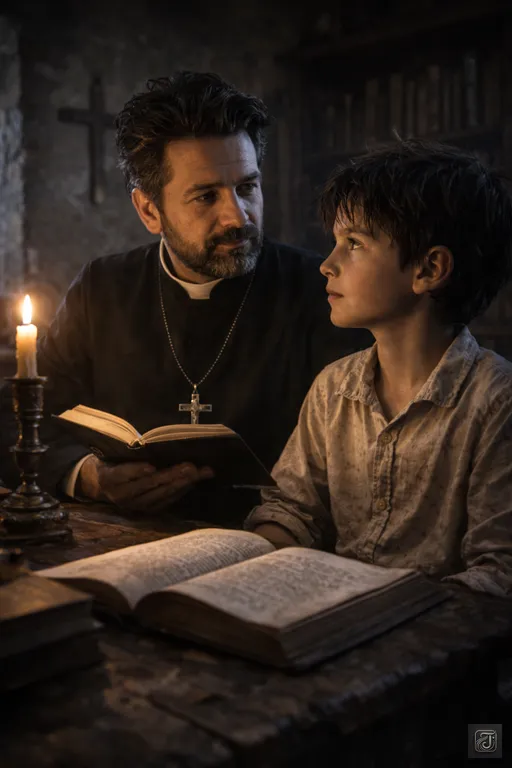
His father was a clergyman.
A man who valued words, loved books, and lived between reason and faith.
He hoped his son would walk the same path.
But the person who shaped Tesla the most
was his mother.
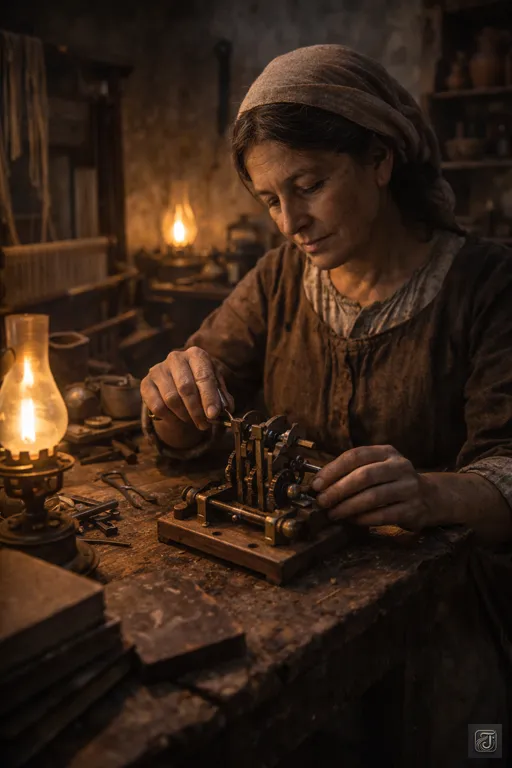
His mother’s name was Đuka Tesla.
She had never received a formal education.
Even so, she was someone who understood the world through her hands.
Inside the house were many small devices she had made herself.
Improvements to the loom.
Ingenious contraptions to ease daily chores.
Ways of repairing broken things so that they worked better than before.
She spoke little,
but her hands were eloquent.
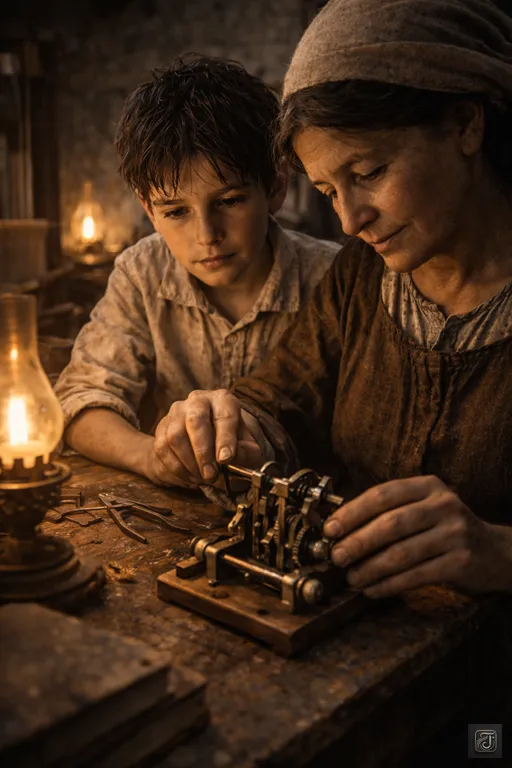
Tesla sat beside his mother, watching the movement of her fingers in silence.
Why bend it here?
Why this order?
Why does it work when done this way?
His mother never explained the theory.
She simply showed the result.
That was enough.
Tesla understood.
“The world is not something to be forced into motion.
If you grasp its mechanisms, it will obey—quietly.”
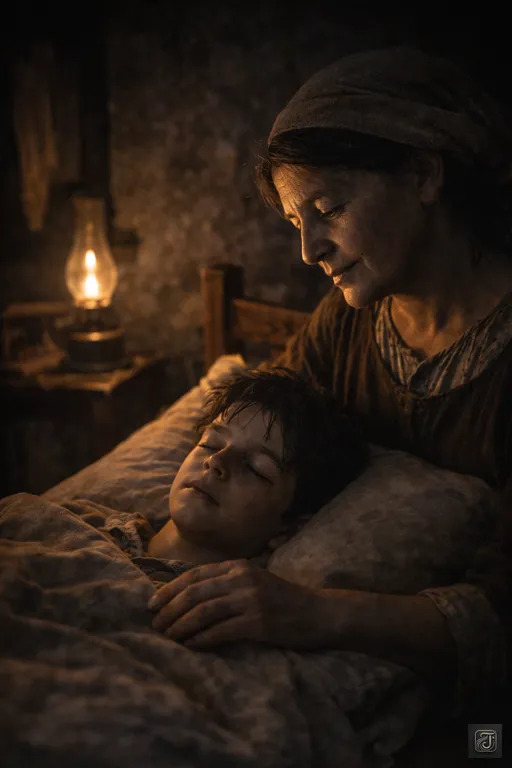
At night, his mother would lower the flame of the lamp and send the family to bed early.
Not to save light.
But so that they would not learn to fear the dark.
Darkness was not dangerous.
It was simply what had not yet been seen.
That was what she believed.
Tesla inherited that way of thinking.
He did not worship light.
Nor did he seek to dominate it.
He only tried to understand it.
Before long, his mother fell ill.
She did not have much time.
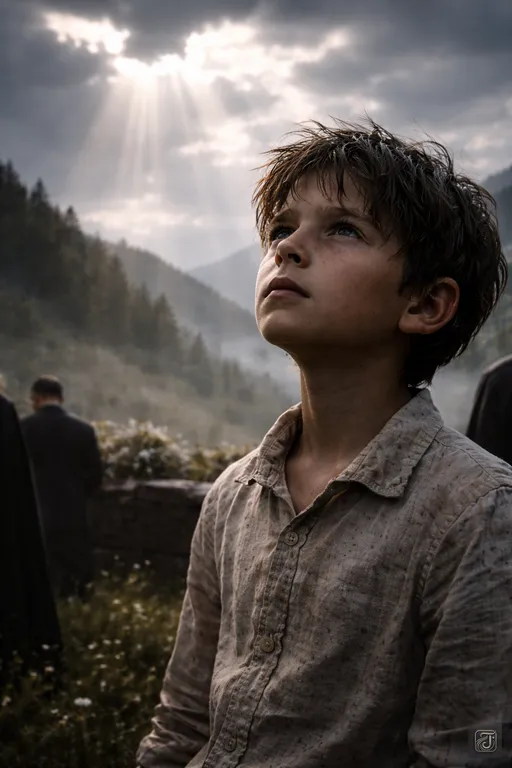
Her death was Tesla’s first loss.
On the day of the funeral, Tesla was looking up at the sky.
Light slipped through a break in the clouds and fell upon the ground.
It was neither warm nor comforting.
It simply existed, indifferent and exact.
In that moment, he understood.
Light is neither kind nor cruel.
Light simply is.
And precisely because of that, everything depends on how humans choose to use it.
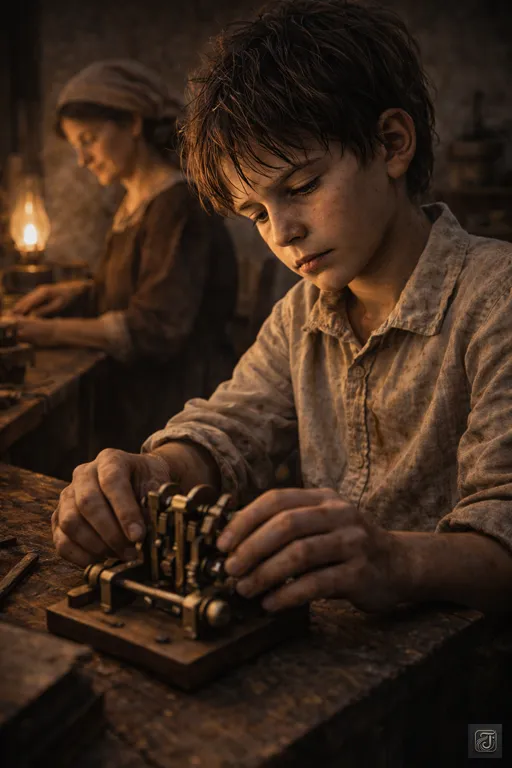
His mother left no final words.
But the way she lived became Tesla’s blueprint.
— Trust what cannot be seen.
— Move your hands.
— Make the world, if only slightly, better.
The light Tesla saw on the night of the storm was not destruction.
It was an ordered force—
an extension of his mother’s hands.
The boy did not know it yet.
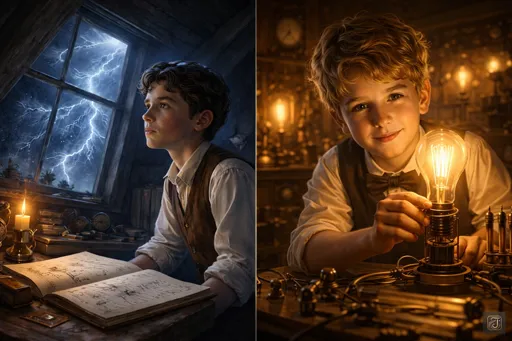
One day, he would enter a world that would call that power dangerous.
And somewhere else, already,
a man who would collide with that world head-on
was gazing at a very different kind of light.
Chapter 2: The Boy Who Sold the Dark
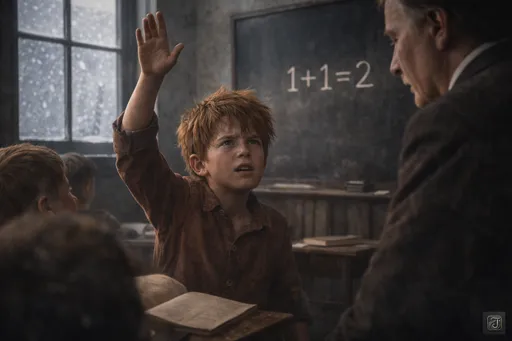
Snow was falling outside the classroom window.
That silence was unbearable to him.
Thomas Alva Edison did not fit into a place called school.
In an arithmetic lesson, the teacher wrote on the blackboard:
“1 + 1 = 2.”
Edison raised his hand.
“If you take one lump of clay and add it to another, you get one larger lump. Is that still two?”
The classroom stirred.
Someone laughed.
The teacher frowned.
Edison was not joking.
He was serious.
He simply could not accept it.
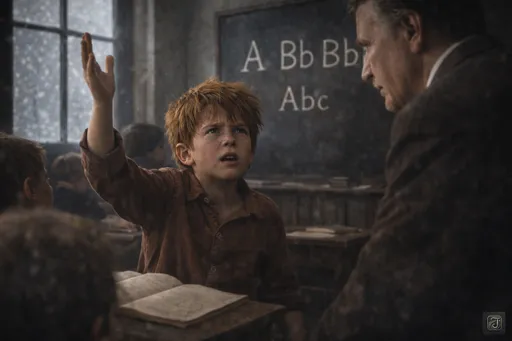
It was the same in language class.
“Why is A pronounced ‘ay,’ and B ‘bee’?”
The teacher said it was simply the rule.
That everyone called them that.
But to Edison, that answer did not sound like an answer at all.
Why was the world decided that way?
Why was questioning forbidden?
His questions halted the lesson,
disturbed the room,
and irritated the teacher.
Even outside of school, he did not stop.

Do eggs really hatch if you keep them warm?
Then the only way to know was to find out himself.
He cradled goose eggs in his arms
and sat for hours inside the goose shed.
Why do things burn?
Then—
Burn them and see.
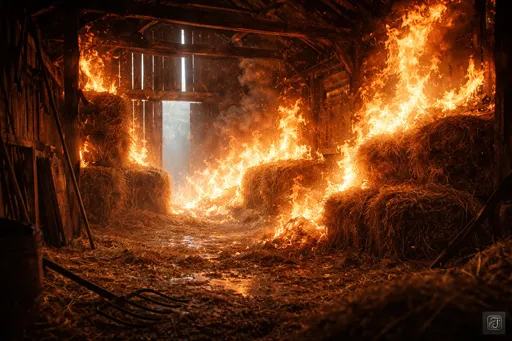
The flames spread, and before he realized it,
The family barn was completely engulfed.
His father scolded him.
The neighbors made a fuss.
The teacher shook his head in disbelief.
And then, at last, came the words spat out like a curse.
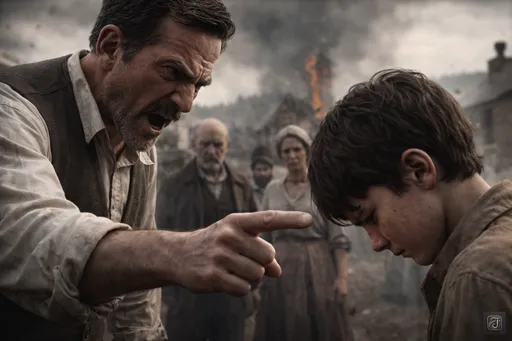
“Your mind is rotten.”
The principal was more bureaucratic.
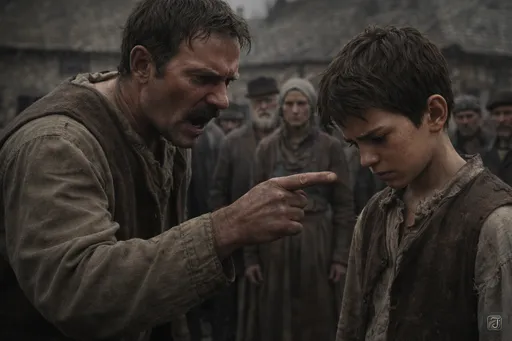
“You are a disturbance to the other students.”
Just three months after enrolling, Edison was expelled from school.
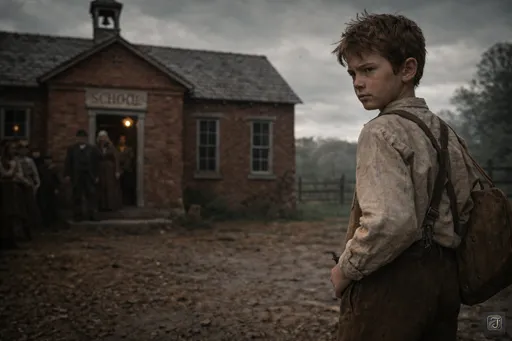
But he never thought he was the one who was wrong.
He simply became convinced that the world was.
School taught him nothing.
Instead, it taught him one single fact.
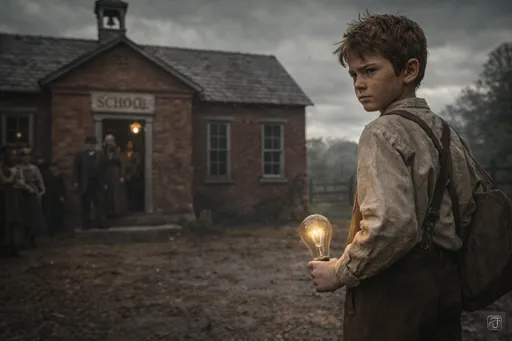
—This world does not welcome questions.
Then questions would have to be reshaped into something that sold.
Edison began to work.
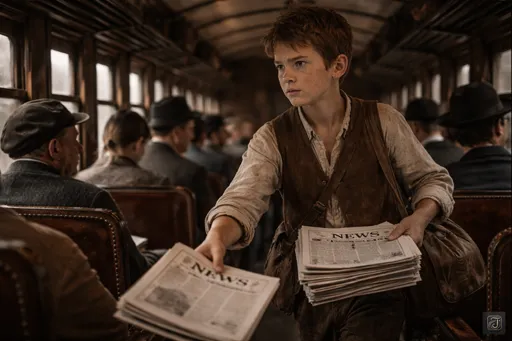
He sold newspapers,
rode the trains,
and learned to read the flow of people.
What sells.
When it sells.
What makes people open their wallets.
He learned—
not logic, but reaction.
Timing over substance.
Results over correctness.
Darkness was not something he feared.
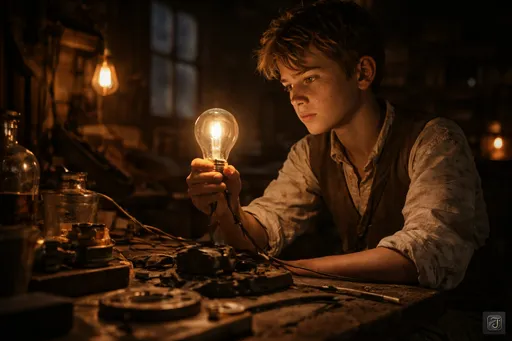
Night was inconvenient—and inconvenience could be turned into money.
What people wanted was light.
Light that was safe.
Light anyone could use.
Light that worked immediately.
He did not love light.
But he understood its demand.
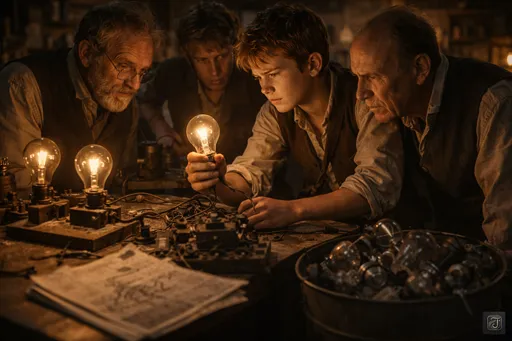
He learned early that he could not do everything alone.
He gathered those more skillful than himself,
those more intelligent than himself.
Results were organized.
What could not be used was discarded.
“I have never failed,”
He would say.
“I have simply found ten thousand ways that do not work.”
That was Edison.
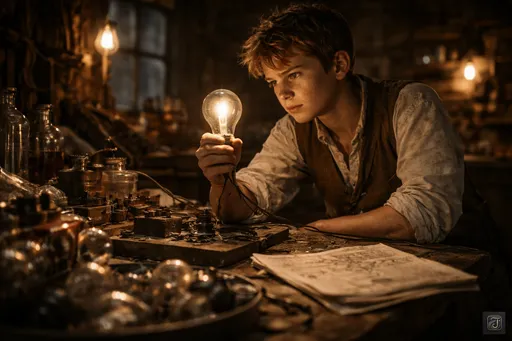
“Genius is one percent inspiration and ninety-nine percent perspiration.”
But that effort did not mean thinking endlessly.
It meant testing, again and again.
It did not have to reach far.
It did not have to be perfect.
If it could be controlled,
if it could be sold,
That was enough.
He understood this well.
People do not buy the future.
They buy today.
—
At the same time,
in a different place,
A single boy was staring at lightning.
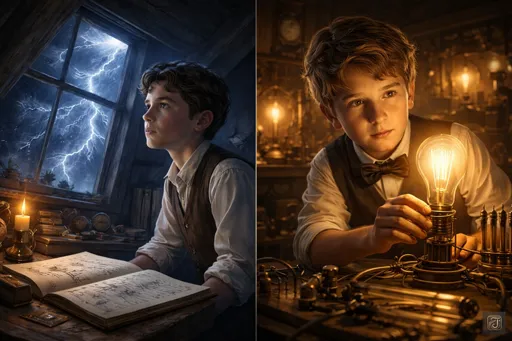
That boy was trying to complete the world inside his mind.
Meanwhile, Edison was learning how to use an unfinished world as it was.
They had not yet met.
And yet, to the same question,
they were already beginning to give opposite answers.
— Why is the world the way it is?
One tried to understand it.
The other tried to use it.
In time, that difference would determine the shape of light itself.
And how they chose to deal with darkness
would completely divide their fates.
Chapter 3: The Encounter — Menlo Park
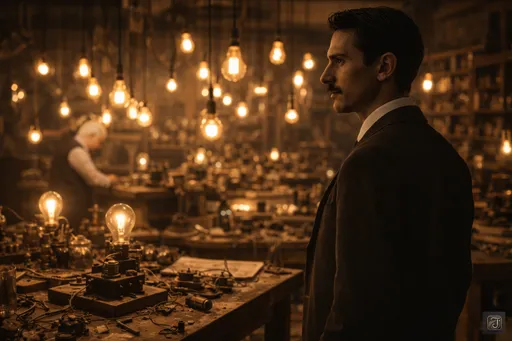
The laboratory felt like night, even in the middle of the day.
Countless lamps hung from the ceiling, and across the desks lay a chaotic sprawl of wires, tools, and half-finished prototypes.
The air was heavy with heat, thick with the mixed scent of oil and metal.
This was Menlo Park.
The kingdom of Thomas Edison.
Nikola Tesla stood quietly.
The fatigue of his journey did not show on his face.
Only his eyes moved—
as if they were absorbing everything in the room.
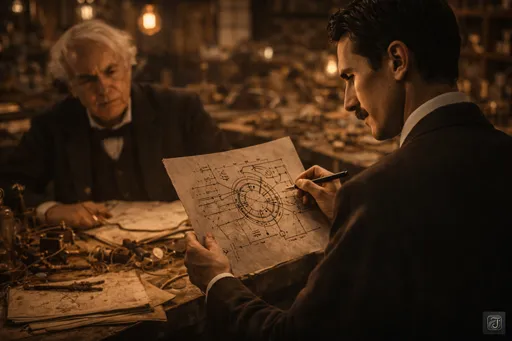
“Are you the man from Europe?”
Edison said it without looking up from his desk.
His gaze moved back and forth between papers and tangled wires.
“Yes. Nikola Tesla.”
“Hmph. So—what can you do?”
That was the entirety of the greeting.
Tesla had prepared an answer.
But instead of words, he chose drawings.
He took a sheet of paper and set the pen in motion.
Circuits.
Magnetic fields.
Flows of rotating force.
Only then did Edison finally raise his head.
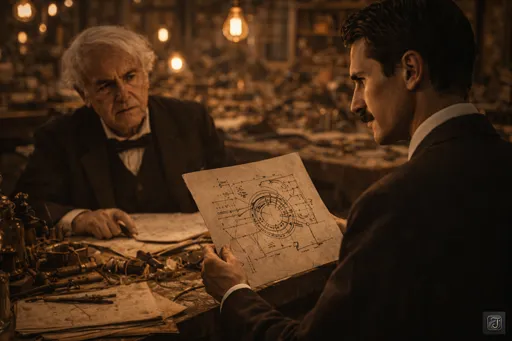
“…And?”
“Alternating current.”
For an instant, the air froze.
“It’s more efficient than direct current.
It can be transmitted over long distances, with far less loss.”
Edison snorted.
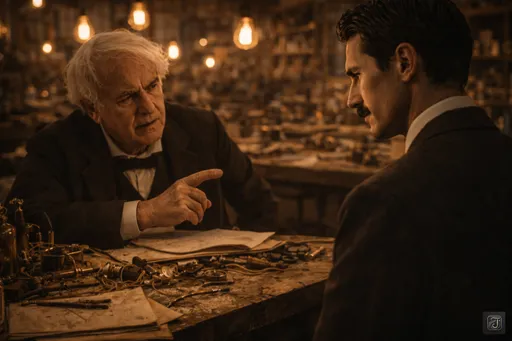
“Long distances? Who would want something like that?”
“Cities will expand.
Power stations won’t need to exist in every town.”
“So you’re saying my business would become unnecessary?”
Tesla chose his words carefully.
“It’s humanity’s business.”
Silence.
Edison slowly rose from his chair.
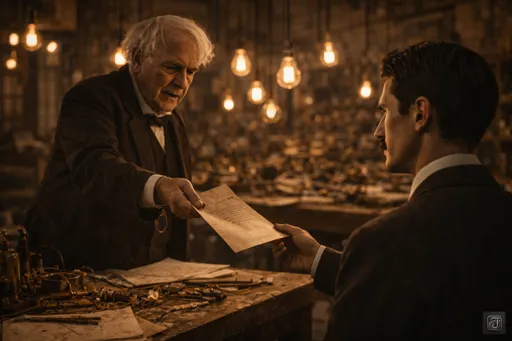
“Theory is fine. But here, the only thing that matters is whether it works.”
With that, he slid another sheet of paper across the desk.
“Improve the existing DC generators. Increase their efficiency. And if you succeed…”
“Fifty thousand dollars.”
Tesla’s eyes flickered, just slightly.
Not because of the amount.
He took the words as a promise.
“I’ll do it.”
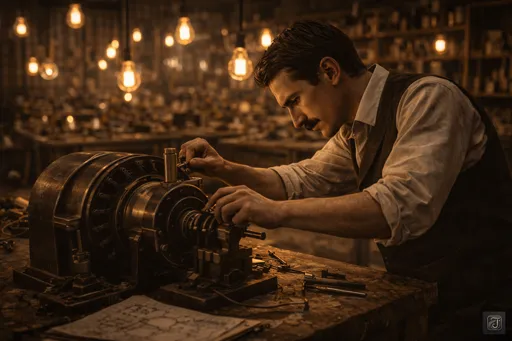
From that day on, Tesla stopped sleeping.
Day and night, the lights in the laboratory never went out.
One by one, he identified the flaws of direct current—
eliminating them in theory, then verifying them in reality.
He stripped away waste, smoothed the flow,
and made the machines quiet.
Weeks later, the generators were no longer the same machines they had been.
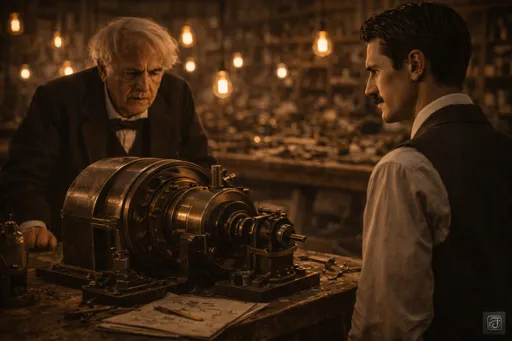
“It’s finished.”
Edison operated the machine in silence.
It turned.
Clearly, it was better.
“…Not bad.”
That was all.
Tesla waited—
for the words that had been promised.
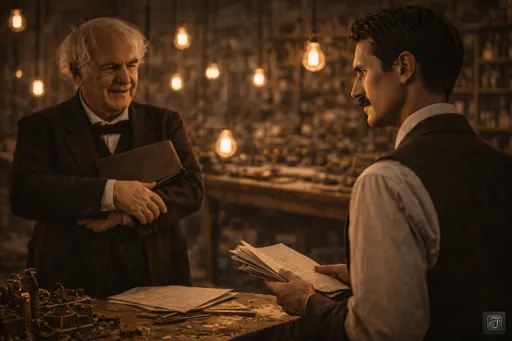
But Edison closed the documents
and said, as if nothing had happened.
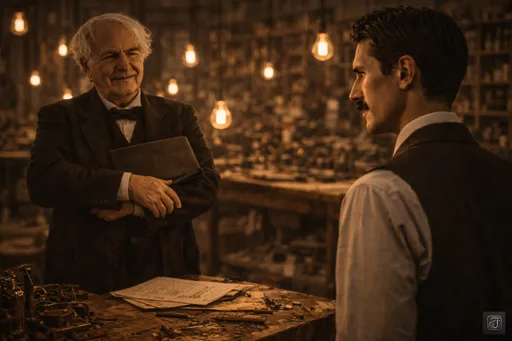
“Good work. But about the money—”
For an instant, the corner of his mouth twisted.
“Just an American joke.”
The sound in the room vanished.
It took Tesla a few seconds to understand.
A joke?
Was he supposed to laugh?
“…A joke?”
“You’re young. Results are paid for with a salary.”
In that moment,
something inside Tesla collapsed with an audible sound.
It wasn’t about money.
Nor was it betrayal.
It was a way of seeing the world.
Tesla quietly gathered his papers.
“You are a man who sells light.”
“Of course. Light that doesn’t sell has no meaning.”
“I want to set light free.”
Edison laughed.
“I don’t dislike idealists. But they don’t fill empty stomachs.”
That was their final conversation.
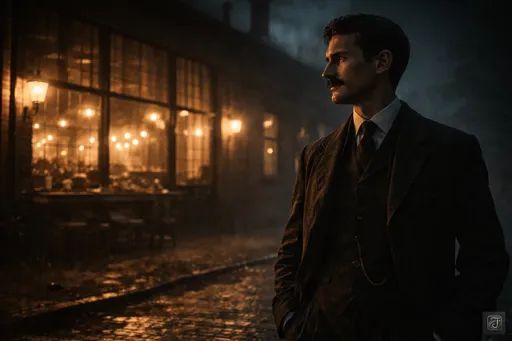
Tesla left the laboratory.
The night air was cold.
Yet his mind was razor-sharp.
They looked at the same light,
lived in the same era,
stood in the same place—
And yet the two would never truly meet.
On that day,
the War of Currents began.
Still unnoticed by anyone.
Chapter 4: Betrayal — The Price of an American Joke
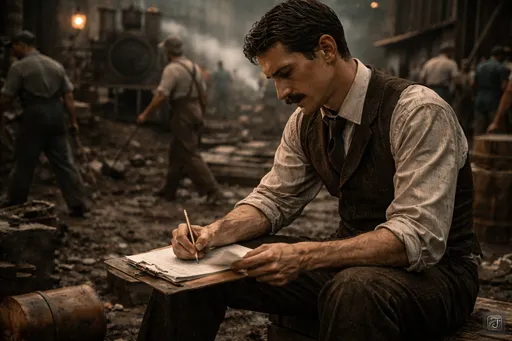
Tesla searched for work.
Not as a researcher.
As a laborer.
He had achievements worthy of a résumé.
But there was no one who could understand them.
The theory of alternating current was too difficult.
Talk of the future did nothing to fill an empty stomach.
His options were few.
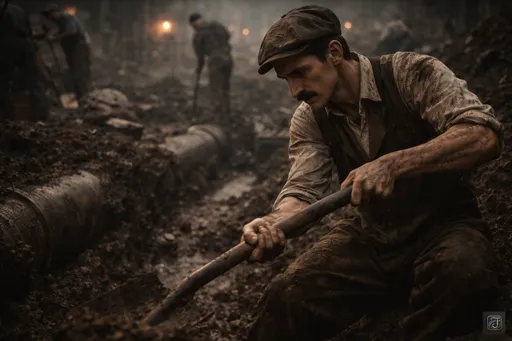
In the morning, he gripped a shovel.
By day and by night, he dug into the earth.
Road work.
Pipes.
Labor buried beneath the city.
There was no light there.
No lightning.
Only damp soil and a dull, grinding fatigue.
At the same time, above the streets, direct-current lights were multiplying.
Edison’s lights.
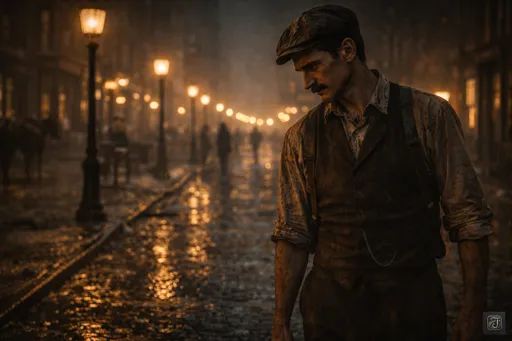
Walking beneath the lamps, Tesla thought.
Why doesn’t it reach?
Why don’t they understand?
Why am I not chosen?
Yet he resented no one.
What angered him was neither people nor the world.
It was time itself.
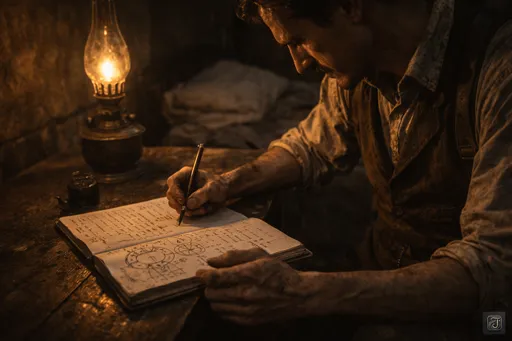
At night, in a cheap lodging house, Tesla opened his notebook.
His fingers trembled, the ink ran thin.
Rotating magnetic fields.
Polyphase alternating current.
Efficiency.
Loss.
Inside his mind, the machines still moved perfectly.
Only reality lagged behind.
One of the laborers spoke.
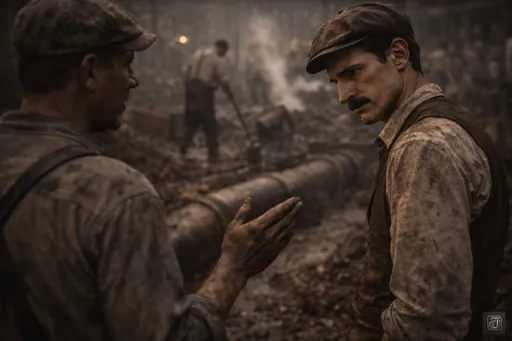
“If you’re that smart, you ought to find a better job.”
Tesla did not answer.
He had no words to explain it.
If he could have explained it, he would not have been in a place like this.
His body finally gave out.
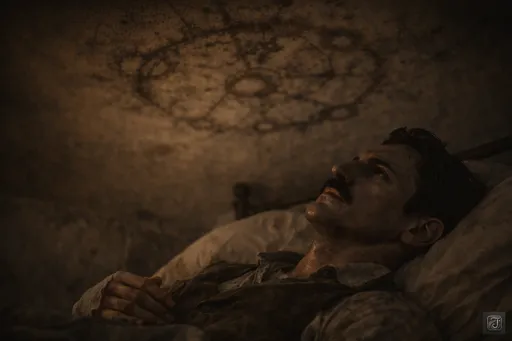
He developed a fever, collapsed, and lost consciousness for several days.
When he awoke, the stains on the ceiling looked like strange patterns.
Lines connected.
They formed circles.
They began to rotate.
In that moment, he was certain.
He was not wrong.
The theory was not wrong.
The world was.
After recovering, he began to walk again.
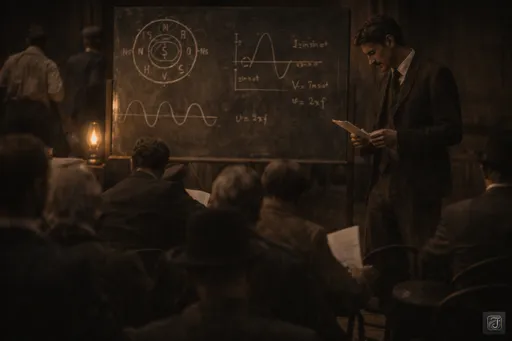
This time, he chose to bow his head.
He gave lectures.
He drew diagrams.
He handed out papers.
Most people stood up and left halfway through.
They did not understand the equations.
Talk of the future was boring.
But there was one man who listened until the very end.
That man spoke.
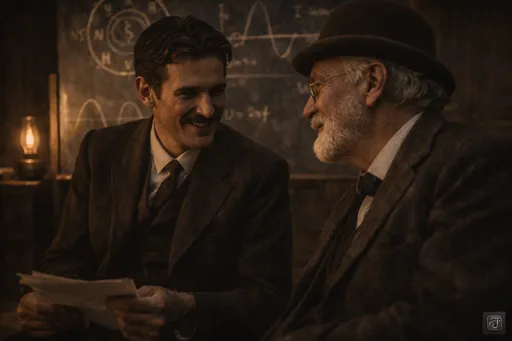
“Does it… really work?”
For the first time, Tesla smiled.
“It is already working. In my mind.”
That encounter would one day draw him back into the light.
But in this chapter, salvation has not yet arrived.
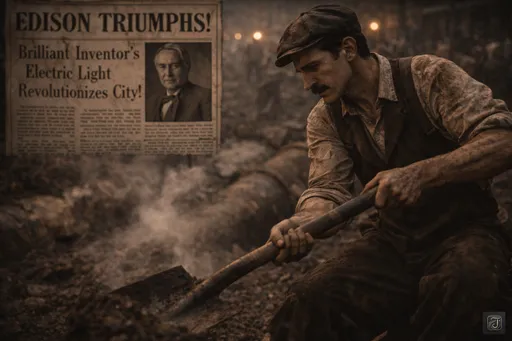
Edison had already succeeded, while Tesla dug into the ground.
The newspapers praised the former and did not print the latter’s name.
The world wanted only the stories of winners.
And Tesla understood that fact sooner than anyone else.
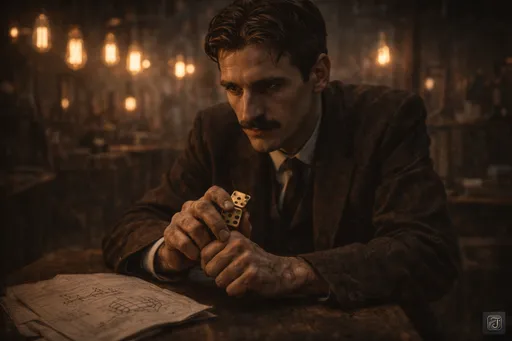
Ideals vanish if they are not protected.
He was being forced to choose.
Adapt to the world,
or make the world wait.
He did not yet speak his answer.
But in the next chapter, he would place a wager.
To drag light once more before the eyes of the world.
Chapter 5: Two Currents
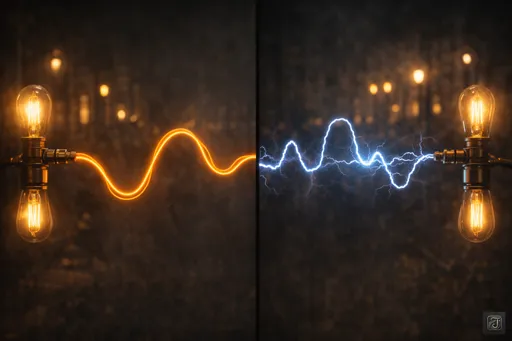
Electricity shared the same name,
yet wore entirely different faces.
One flowed straight.
Its beginning and end were clear, unwavering.
But it could not travel far.
The other swayed.
It moved back and forth, changing form as it advanced.
Yet it was precisely that fluctuation that gave it the power to cross great distances.
Direct current and alternating current.
The two were not merely different technical systems.
They were different ways of seeing the world.
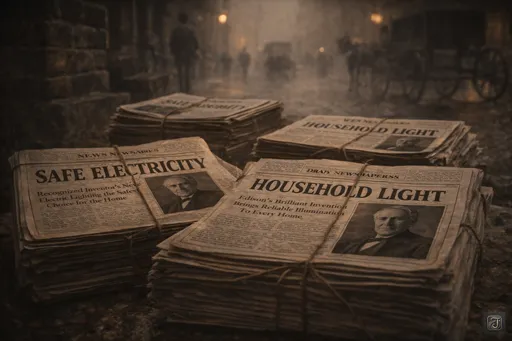
In the morning, bundles of newspapers were delivered.
The smell of fresh ink was strong.
The headlines were short and easy to understand.
— “Safe Electricity”
— “Light for the Home”
People nodded at those words.
What can be understood turns into reassurance.
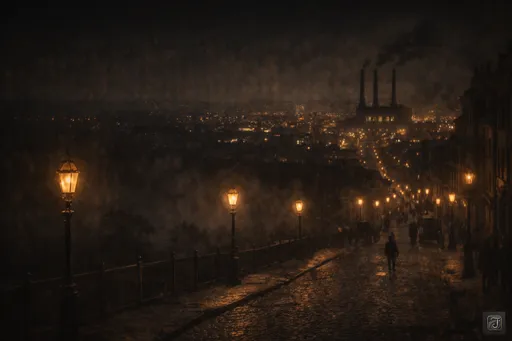
There was certainly more light.
But the light was always close at hand.
The farther one moved from the power station, the weaker it became.
The city was bright.
Outside the city, darkness still remained.
Edison believed in direct current.
It was precise, easy to control, and above all, easy to understand.
Electricity was dangerous.
That was precisely why it should be managed nearby.
It should be used within a distance the human eye could oversee.
That way of thinking,
wrapped in the word safety,
gradually became common sense.
Meanwhile, Tesla spoke of alternating current.
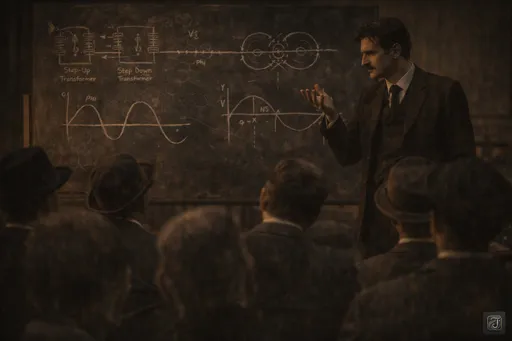
To send power over long distances, one need only raise it once, then lower it where necessary.
The logic was simple.
But to understand it required believing in things that could not be seen.
Transformation.
Phase.
Rotating magnetic fields.
They could not be held in the hand.
The more they were explained, the more people’s eyes clouded over.
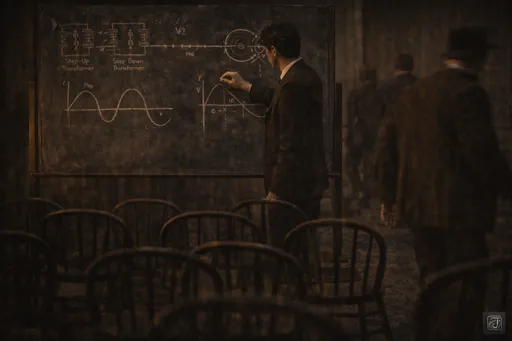
A lecture hall.
Rows of chairs.
Yet empty seats stood out.
Each time Tesla drew a line on the blackboard, someone quietly stood up and left.
What lingered was not equations, but fear.
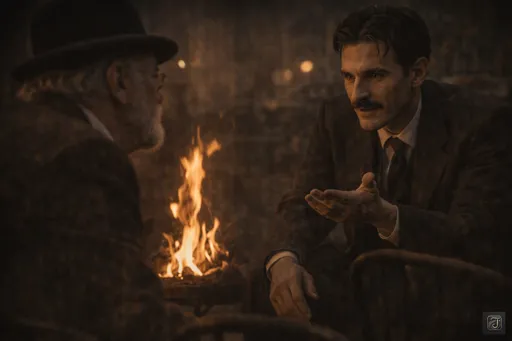
“Isn’t it dangerous?”
That was the first question people asked.
“If handled incorrectly, it is dangerous.”
“But fire is the same.
And yet, people still use fire.”
Fire gave birth to civilization.
Electricity was meant to do the same.
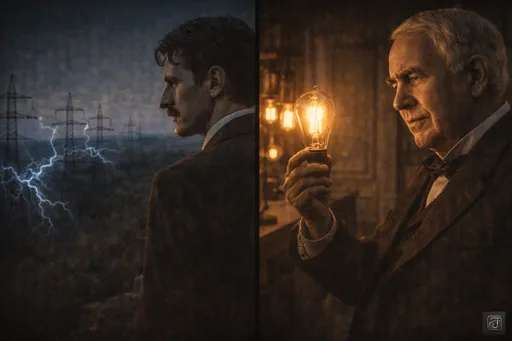
To Tesla, electricity was not something to dominate.
It was something to understand—
something to coexist with as a flowing force.
To Edison, electricity was simply a product.
It had to be shaped into something that would sell,
stripped of anxiety, and placed on the market.
He knew that what people desired was not the future,
But reassurance today.
Which was right?
There was no answer to that question.
At least, not in the world as it was then.
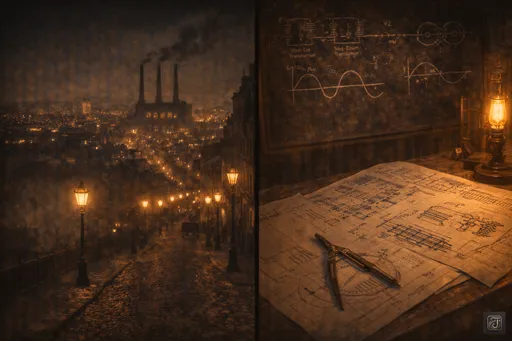
Direct current was already lighting the streets.
People were satisfied.
Alternating current was still invisible.
It existed only in drawings on desks and lines on blackboards.
Yet it was precisely that unseen electricity that held the potential
to carry light beyond the city,
beyond borders.
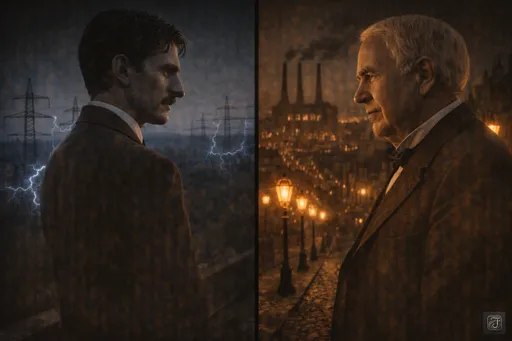
Edison: “People fear what they cannot understand.”
Tesla: “And that is precisely why those who understand are needed.”
The two forms of electricity could not coexist in the same city.
One would remain.
The other would withdraw.
Would the city be covered by controlled light,
or by liberated light?
Safety—
Or for the future?
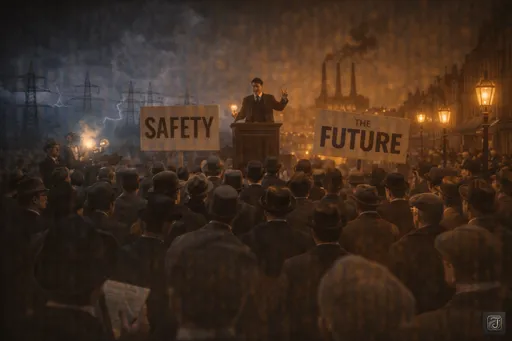
Investors, politicians, newspapers—
and the crowds who knew nothing at all.
Electricity itself simply flows, in silence.
But how that flow is used determines the shape of civilization.
In time, light would give rise to conflict.
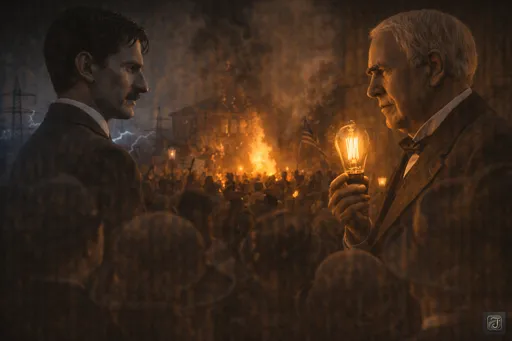
Conflict would spread fear in the name of light.
The two currents had not yet thrown sparks.
But the war had already begun.
Chapter 6: The War of Currents — Fear as a Weapon
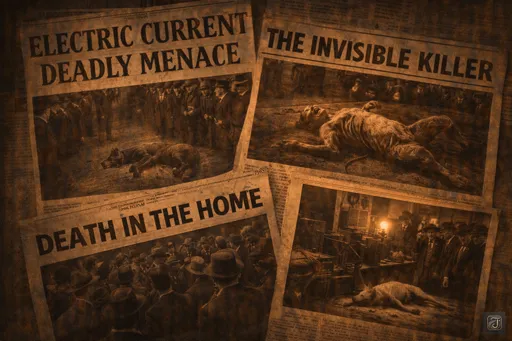
What moved first was not theory.
It was fear.
The newspapers fanned the flames.
The headlines were short and sensational.
— “Alternating Current: Dangerous”
— “The Invisible Killer”
— “Death Creeping into the Home”
Beneath the articles were photographs.
Electrocuted animals.
Twisted bodies.
Crowds frozen in shock.
There was almost no explanation.
Only results.
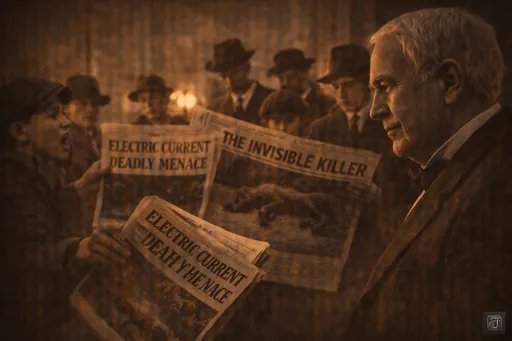
People believe what they see before they believe reason.
Edison understood this.
He did not speak publicly.
He issued no statements condemning alternating current.
He simply released the necessary stories,
to the necessary places,
in the necessary form.
Someone said it.
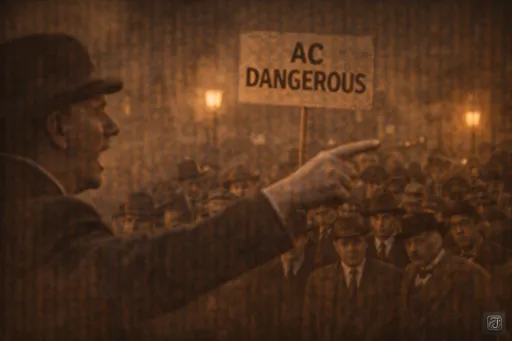
“Alternating current is dangerous.”
No one remembered who had said it first anymore.
But not knowing did not matter.
What mattered was that many people believed it was dangerous.
That alone was enough.
What was needed was not truth.
It was impression.
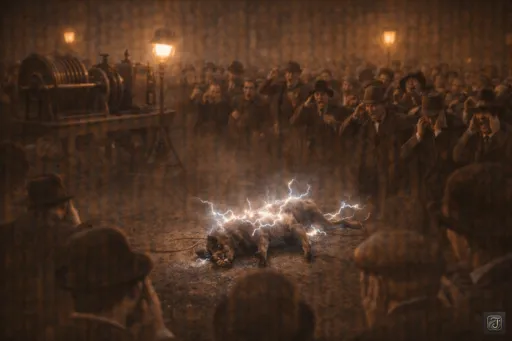
A public demonstration is held in a city square.
Copper wires.
A generator.
And an animal.
The switch is thrown.
A flash of light.
The crowd screams.
“This is alternating current.”
That is the only explanation.
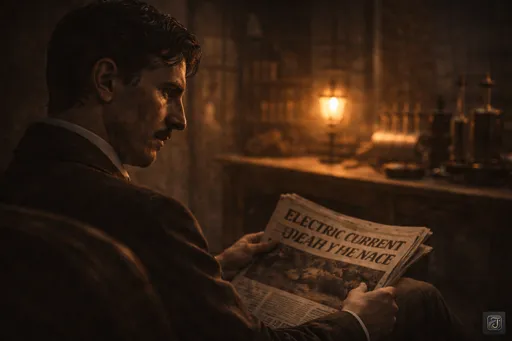
Tesla heard about it afterward.
He did not see it himself.
There was no need to.
He understood.
Electricity had not killed.
People had.
But that distinction did not reach the crowd.
Fear is fast.
Understanding is slow.
Edison’s camp made its next move.
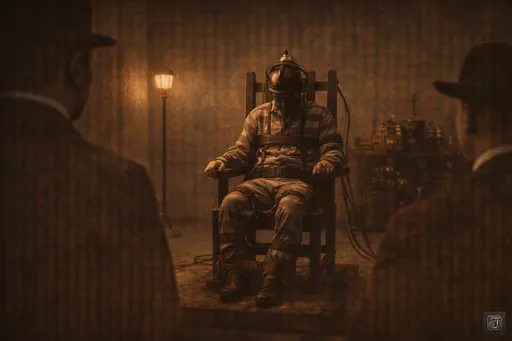
Capital punishment.
The electric chair.
“If we’re going to do it,
we should use the most dangerous electricity.”
So it was whispered.
The one chosen was alternating current.
On the day of the execution,
reporters gathered.
A silence like a spectacle filled the air.
The switch was thrown.
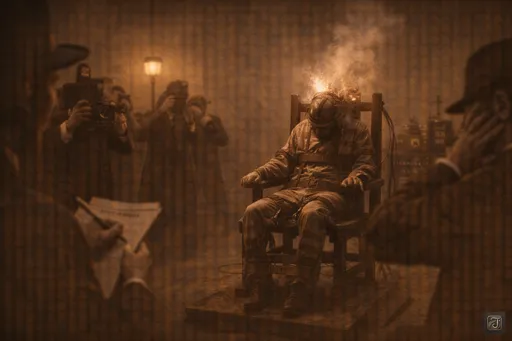
Failure.
Agony.
A second surge of current.
People turned their eyes away—
Yet they still watched.
The next day’s newspapers wrote, with composed restraint:
— “Alternating Current Proven to Take Human Life”
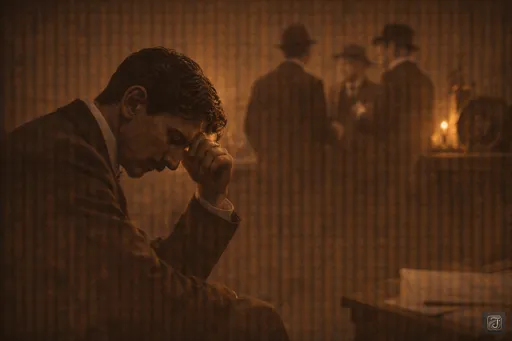
Tesla did not read the article.
There was no need to.
He was alone.
There were no words left to defend alternating current.
Engineers fell silent.
Investors kept their distance.
Politicians watched public opinion.
Fear was convenient.
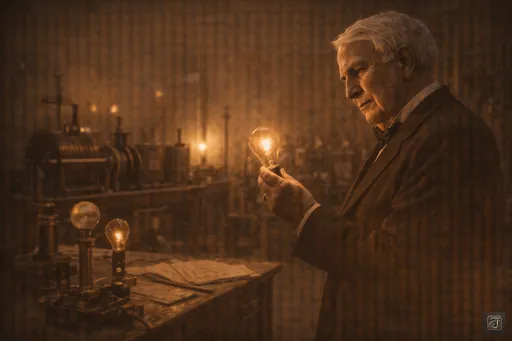
Edison continued working on new improvements in his laboratory.
To him, this was not a war.
It was a market adjustment.
What does not sell disappears.
What is dangerous is avoided.
That was all there was to it.
He was not aware of any evil in himself.
If anything, he believed he was preserving order.
“People choose safety.”
That was what he believed.
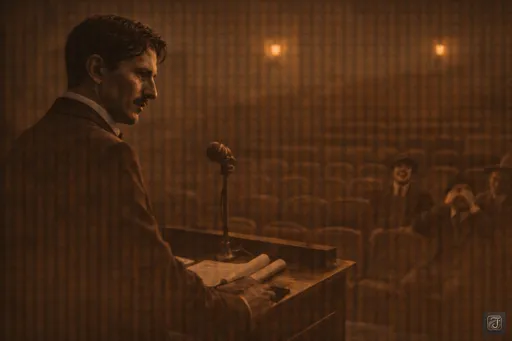
Tesla stood at the lectern.
Empty seats stood out.
“Alternating current can be controlled.”
Someone laughed.
“A controllable killer?”
The hall stirred.
Tesla lost his words.
There was logic.
There was proof.
But there is no equation that can defeat fear.
In this chapter,
The way the war would be fought was decided.
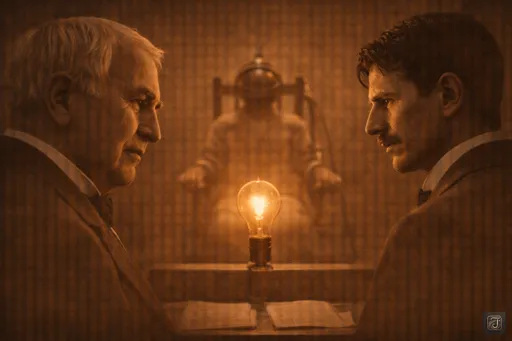
It was not theory versus theory.
Nor proof versus proof.
It was fear versus the future.
And once this battle began,
Someone would be hurt.
Light was no longer neutral.
Someone’s life was exchanged
to prove someone else’s righteousness.
That was the reality of the War of Currents.
Yet even this age of fear would come to an end.
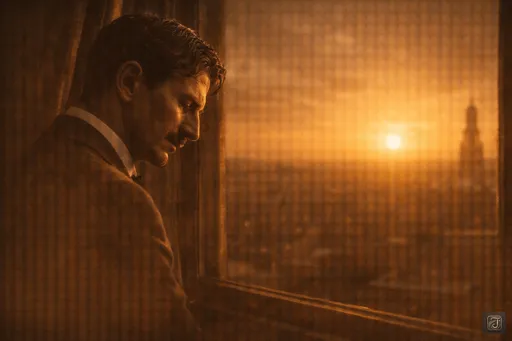
People would, sooner or later, see the light with their own eyes.
Until that day came, Tesla had no choice but to endure.
Chapter 7: The Night of Light — The Chicago World’s Fair
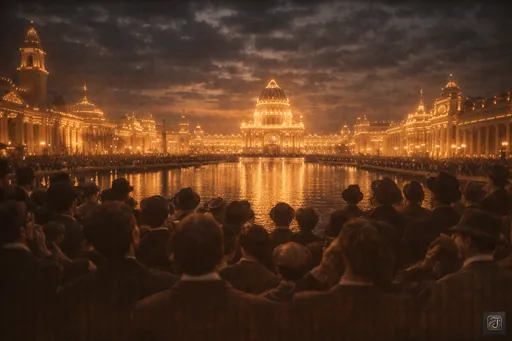
Night fell.
But this night was unlike any humanity had ever known.
Chicago, 1893.
As the sun set, the grounds of the World’s Columbian Exposition fell silent.
People looked up at the sky, half in doubt.
Rumors had spread.
An unheard-of number of lightbulbs.
An unfamiliar system.
And—alternating current.
Dangerous.
Electricity that kills.
That was what the newspapers had written.
Still, people gathered.
Fear and curiosity have always faced the same direction.
Without a signal, the lights suddenly came on.
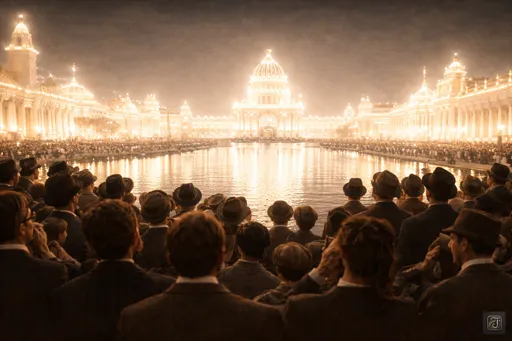
Not one.
Not ten.
Not a hundred.
Tens of thousands of lights
tore through the night all at once.
The grounds rose, bathed in white.
The outlines of buildings.
The shadows of statues.
Human faces.
No one screamed.
No one ran.
They simply held their breath.
The light did not flicker.
It did not explode.
There was no sound.
No smell.
It was quiet.
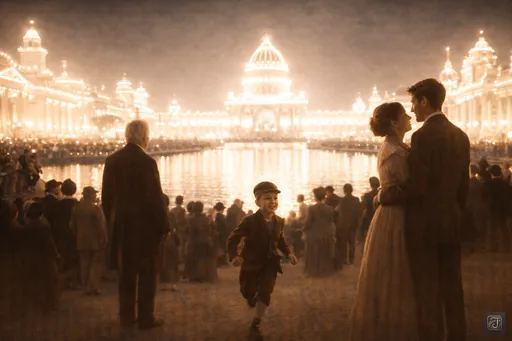
Children ran.
The elderly stopped in their tracks.
Lovers stood beneath the light, at a loss for words.
“…It’s not dangerous.”
Someone murmured it softly.
That single sentence erased the fear surrounding alternating current.
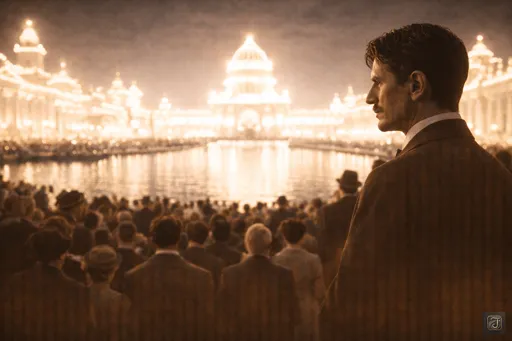
Tesla stood within the crowd.
He did not step onto the stage.
He offered no explanation.
He simply watched.
The light that had once existed only in his mind
now flowing through reality.
Someone nearby whispered.
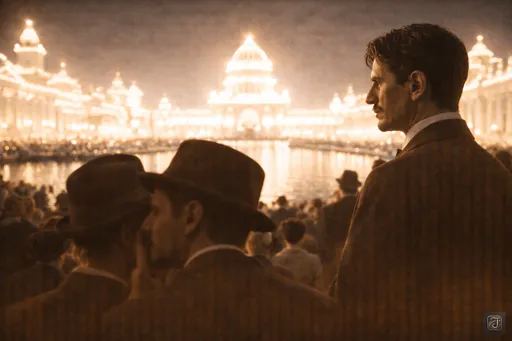
“Is this… alternating current?”
Tesla did not answer.
There was no longer any need to.
The light spoke for itself.
Far away, in another city, Edison was reading the newspaper.
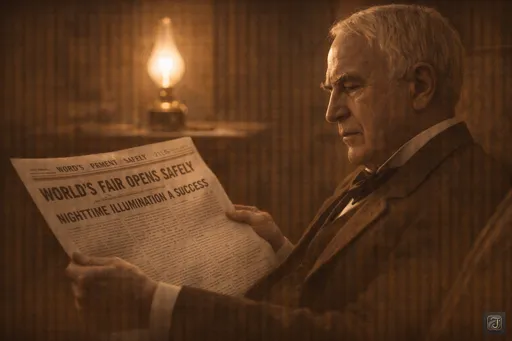
The headlines were restrained.
— “World’s Fair Opens Without Incident”
— “Success in Nighttime Illumination”
The word danger appeared nowhere.
Edison set the paper down.
He said nothing.
Numbers are honest.
Cost.
Scale.
Efficiency.
He knew that numbers do not lie.
But he also knew—
The human heart is not as wise as numbers.
Even so, something inside his chest felt rough, unsettled.
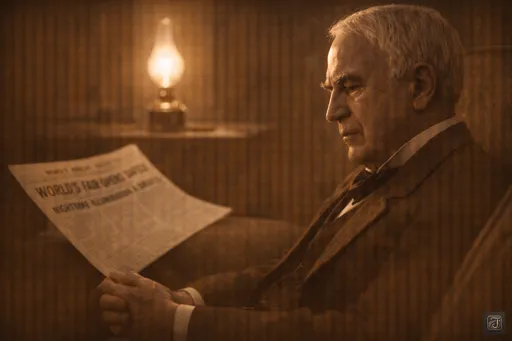
In theory, the contest was already decided.
But he knew this as well:
markets do not move after a single night.
That night, Tesla gave a speech.
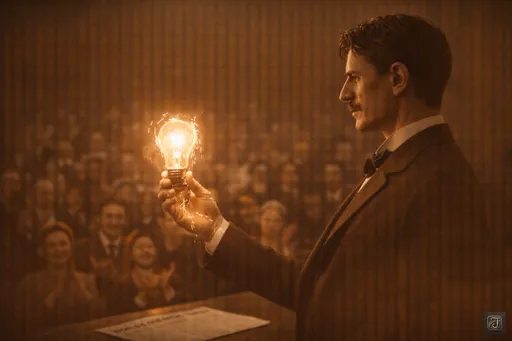
He picked up a lightbulb.
He let electricity flow through his own body.
Light danced in the palm of his hand.
No screams rose.
Applause erupted.
Fear turned into laughter.
In that moment, the current of the War of Currents shifted.
The next day, the newspapers wrote:
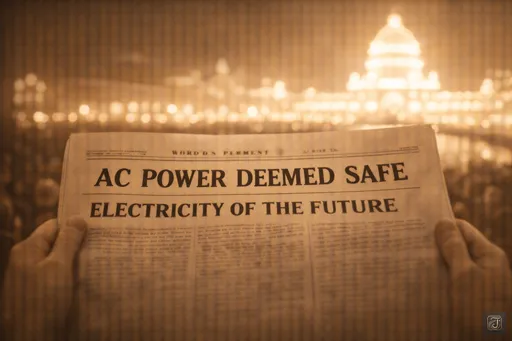
— “Alternating Current: Not Dangerous”
— “The Electricity of the Future”
The wording was still cautious.
But it was no longer fear.
For the first time, people had seen it with their own eyes.
That electricity did not kill,
that it illuminated cities,
that it erased the fear of the night.
From that night on,
alternating current was no longer denied.
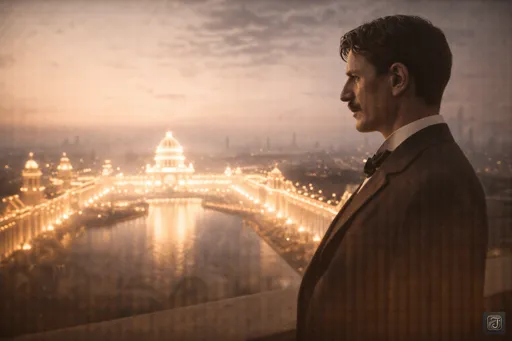
But Tesla did not celebrate victory.
He knew.
This was only the beginning.
Light was not meant to remain confined within cities.
Farther.
To more places.
By the time the night ended, the sky over Chicago had grown pale with artificial light.
For the first time, humanity spent a night that had conquered darkness.
And that light was already moving, quietly, toward the next battlefield—
to where the power of water awaited.
Chapter 8: Niagara — The Day the World Was Decided
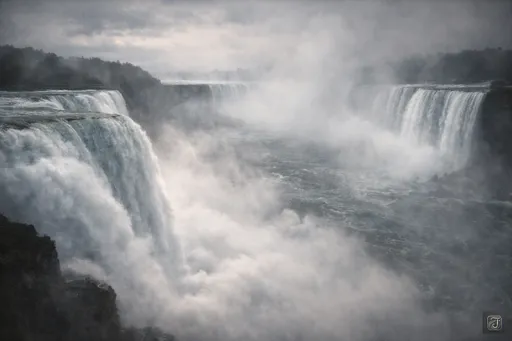
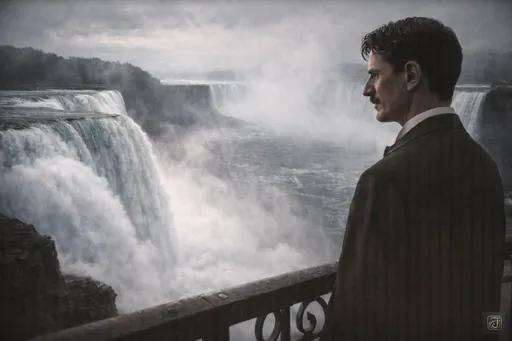
Water does not stop.
Niagara Falls paid no heed to human convenience.
It simply kept falling.
A roar.
Mist.
An unending flow.
It was a force humanity was facing for the first time—
a power beyond control.
To build a power station here—
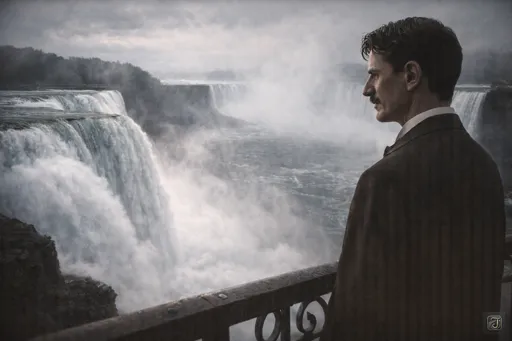
When the plan was proposed, many people shook their heads.
Too powerful.
Too violent.
Too far away.
But Tesla saw it differently.
Water was ideal.
Its flow was constant,
it would not run dry,
and it would never be exhausted.
The problem was how to carry it.
With direct current, it was impossible.
The distance was too great.
The losses were too large.
Building more power stations would defeat the purpose.
With alternating current, it was possible.
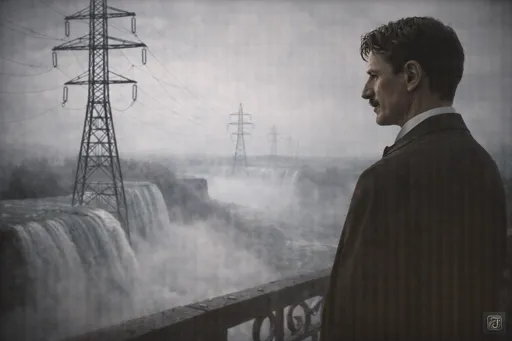
Raise it.
Send it.
Lower it.
A simple principle.
But to believe in it required the courage
to accept what cannot be seen.
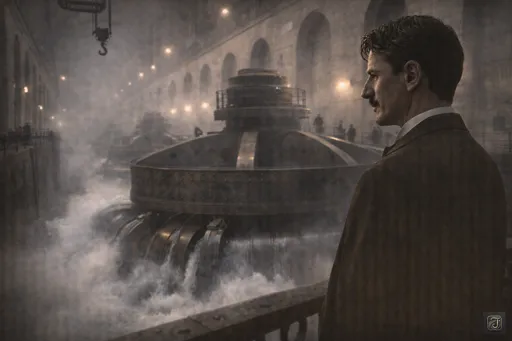
Construction moved forward.
Massive turbines.
Spinning shafts.
Water set iron in motion.
Tesla did not stand at the site.
He gave no instructions.
He drew no plans.
His work was already finished.
The theory was complete.
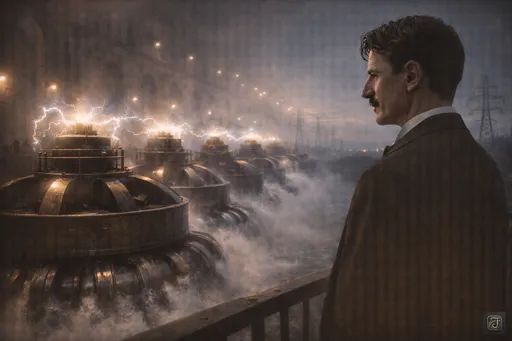
The switch was thrown.
Water fell.
The turbines turned.
The generators hummed.
Electricity was born.
And then—
It went far away.
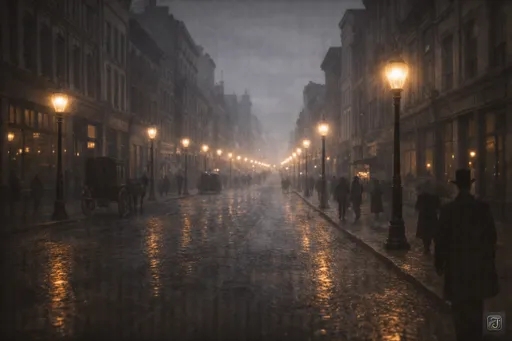
1896.
Electricity from Niagara reached Buffalo.
Streetlights came on.
One.
Then another.
No one shouted.
No one applauded.
Ordinary life simply began.
In that moment, the world was decided.
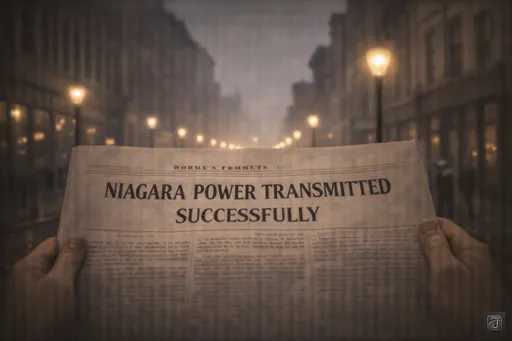
The next day, the newspapers ran a quiet headline.
— “Niagara Hydropower Transmission Succeeds”
There were no flashy words.
But there was no room for denial.
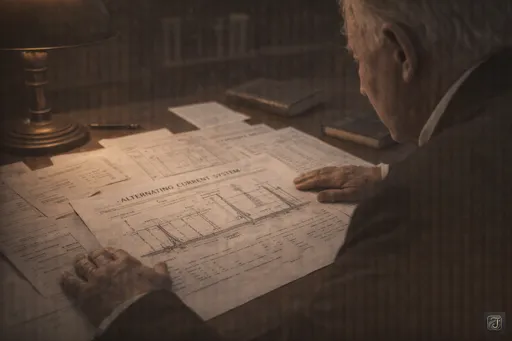
Edison reads the report.
He looks at the numbers.
Distance.
Cost.
Stability.
He keeps his hand on the desk and does not move for a while.
Direct current has lost.
That is the market’s verdict.
He does not get angry.
He does not shout.
He does not strike the desk.
He simply thinks about the next business.
That was his way.
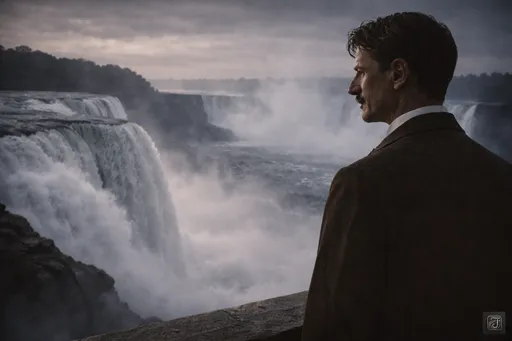
Tesla was watching the waterfall.
The water did not change.
Whether it won or lost.
He did not smile.
Victory had never been his goal.
That the light reached far away.
That it erased the fear of night from the lives of many people.
That alone was enough.
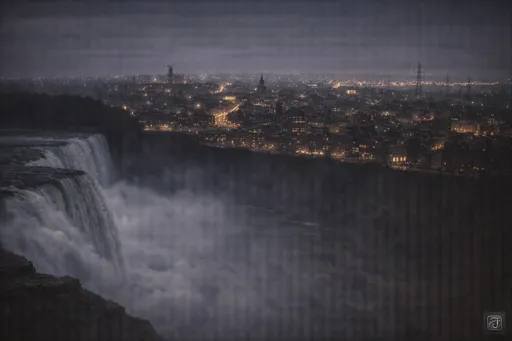
On that day, alternating current began to flow as the bloodstream of the world.
Cities were freed from their power stations,
and night lost its sense of distance.
Yet no one shouted his name.
Heroes were unnecessary.
What was needed was a system.
Niagara continues to fall today,
unaware of humanity’s choice.
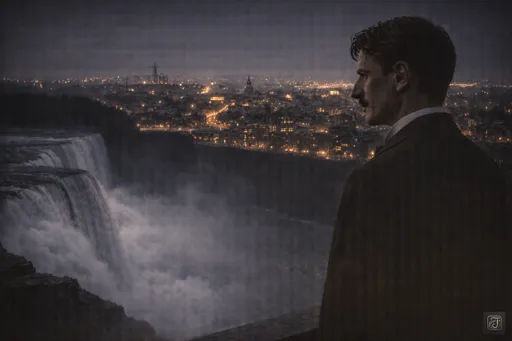
On that day, alternating current began to flow as the bloodstream of the world.
Cities were freed from their power stations,
and night lost its sense of distance.
Yet no one shouted his name.
Heroes were unnecessary.
What was needed was a system.
Niagara continues to fall today,
unaware of humanity’s choice.
Chapter 9: Abandoned Wealth
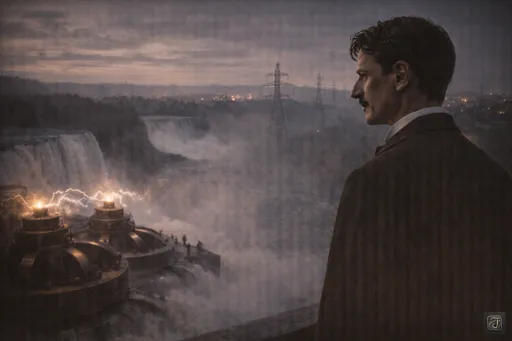
Victory does not always bring blessings.
After the success at Niagara, the world began to tilt decisively toward alternating current.
Power grids spread outward, and plans for power stations rose one after another across the globe.
Tesla’s patents stood at the very center of it all.
The rotating magnetic field.
Polyphase alternating current.
The mechanism of transformation.
They were becoming the very foundation of civilization.
He could have claimed immense wealth.
Patent agreements.
Licensing fees.
Royalties.
As long as alternating current was used, money would continue to flow to him—
sums so vast that he could have bought several lifetimes without lifting a finger.
But at the same time, the world was presenting him with another reality.
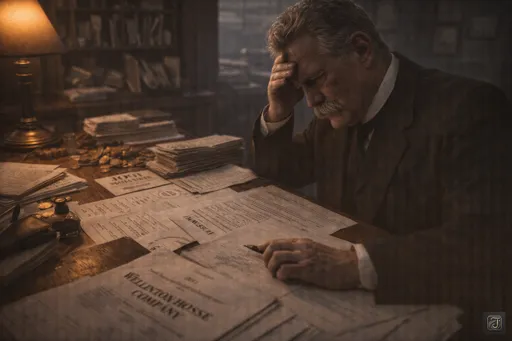
George Westinghouse’s company was in crisis.
Capital expenditures.
Lawsuits.
A war of attrition with Edison’s camp.
Alternating current was winning—
But that victory was devouring money at a terrifying rate.
Banks began to keep their distance.
Investors voiced their unease.
“The patent fees are too heavy,”
Someone said.
And it was true.
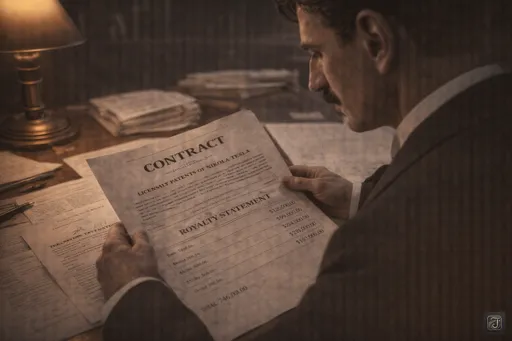
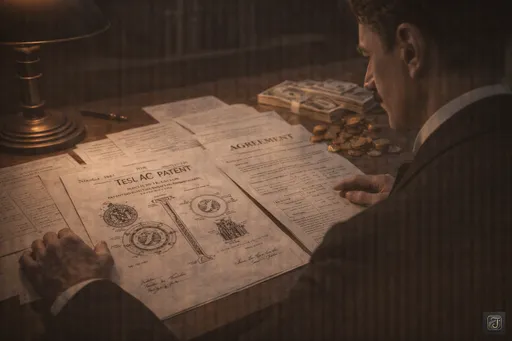
Tesla sat before the documents.
There, his name and his worth were laid out as numbers.
He stared at those figures for a long time.
If he honored this contract—
He would become wealthy.
He would never have to dig in the ground again.
He would no longer need to force himself to give lectures no one understood.
But Westinghouse’s company would collapse.
The spread of alternating current would be delayed—severely.
And the path of light would be closed once more.
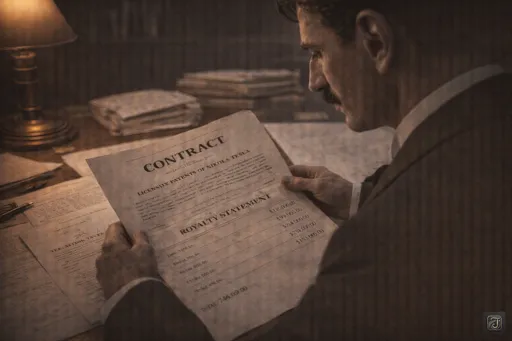
Tesla stood at a crossroads.
Vast personal wealth—or the future of humanity.
Tesla picked up the pen.
His hand did not tremble.
He drew a line across the contract.
The royalty clause—
He erased it with his own hand.
Tesla chose the future of humanity.
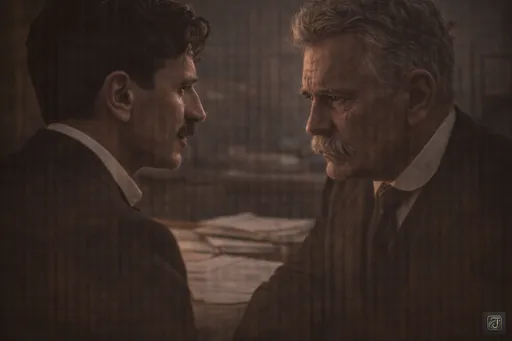
“Why?”
Westinghouse asked, his face unable to hide his disbelief.
Tesla answered quietly.
“Light is not something to be hoarded.”
To him, invention was not a bargaining chip.
It was something meant to be released.
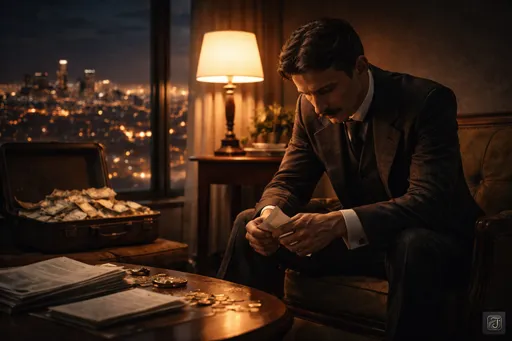
At that moment, he abandoned wealth.
No one forced him.
No one deceived him.
He chose it himself.
The company would survive.
Alternating current would spread.
The world would grow brighter.
And Tesla—
was left behind, alone.
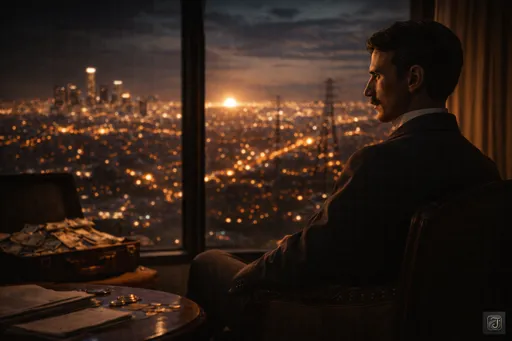
In later years, people would say—
—If only he had protected his patents.
—If only he had chosen reality.
But such ifs never existed in his life.
He knew.
Wealth was not the goal.
That light could travel far—
That was his reward.
On this day, Tesla suffered his second defeat.
The first was the day he was betrayed by Edison.
The second was the day he chose, by his own hand,
to let everything go.
Yet he did not regret it.
Regret is a word reserved
for those who do not believe in the future.
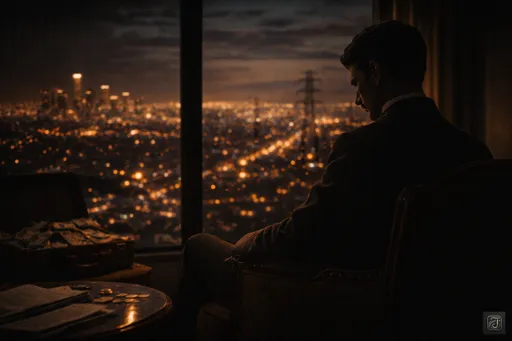
The light will not return.
It has left his hands
and begun its journey around the world.
And he himself—
once more,
returns
to the shadows.
Chapter 10: The Victor — Edison’s Night
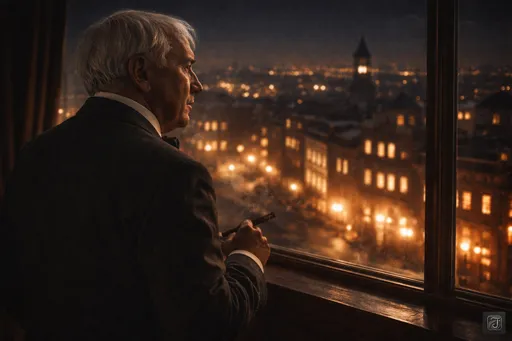
Night was on his side.
The city glowed with electric light.
Buildings stood in orderly rows.
People did not question that light—
It had blended into their lives so completely
that there was no reason to doubt it.
Thomas Edison stood by the window,
looking out over the illuminated nightscape.
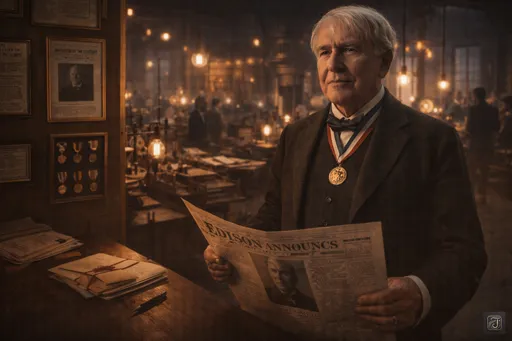
His name appeared in the newspapers.
The Wizard of Invention.
A symbol of modernity.
The American Dream.
Medals.
Praise.
Invitations.
He had obtained everything.
His laboratories expanded,
his staff grew,
and capital continued to circulate.
People said—
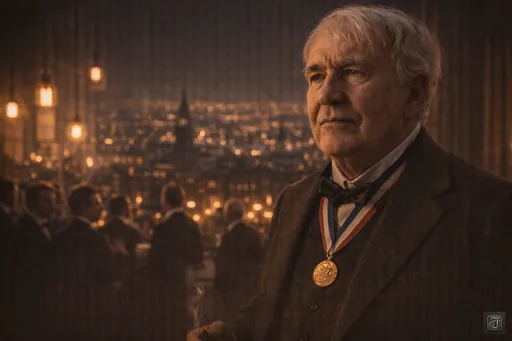
“He lit up the world.”
Edison did not deny those words.
There was no reason to.
He had done the right thing—
at least within the rules of this society.
He sold safety,
managed fear,
and expanded the market.
The world chose his way.
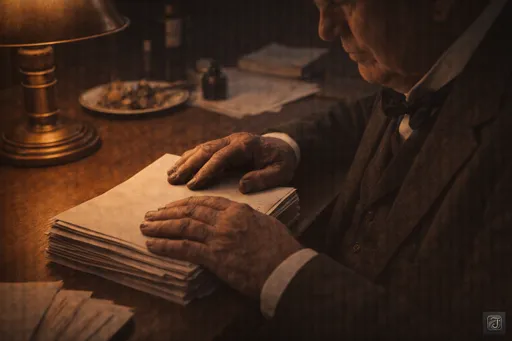
That night, he eats alone.
Not lavish.
Efficient.
Nothing wasted.
When the meal is finished,
He turns to his desk.
He picks up a stack of papers and, without thinking, aligns their edges.
One sheet, then another.
When a fold slips out of line, he presses it back gently with his fingertips.
Those fingers are darkened.
Ink.
Oil.
Metal dust.
No matter how many times he washes them,
They never come completely clean.
Edison doesn’t mind.
Stains are proof that work has been done.
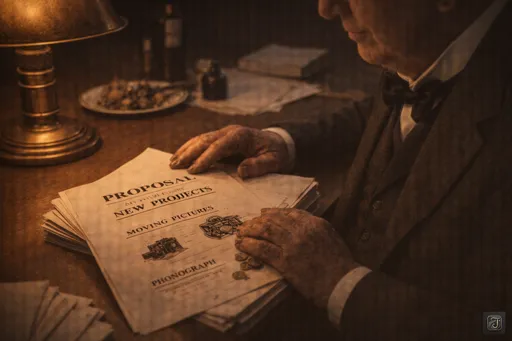
On the desk lies a new proposal.
It has nothing to do with electricity anymore.
Motion pictures.
The phonograph.
The next thing that will sell.
Invention is no longer the goal.
Edison suddenly thinks of the past.
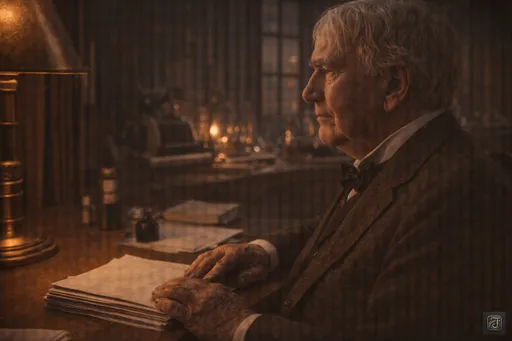
A tall young man who came from Europe.
A man who drew diagrams and spoke of the future.
The name—
it doesn’t come to him right away.
He thinks for just a moment,
then stops.
The past does not generate profit.
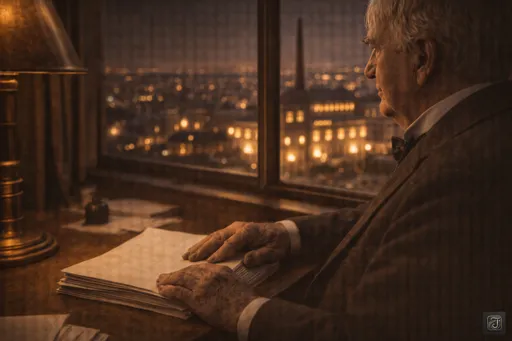
He straightens the edges of the paper once more.
The folds line up neatly.
Outside the window,
the lights of direct current flicker.
The power station is close—
a distance that can be controlled.
Security.
Control.
A world that can be calculated.
This was the light he had wanted.
And yet, within that light,
He had lost something.
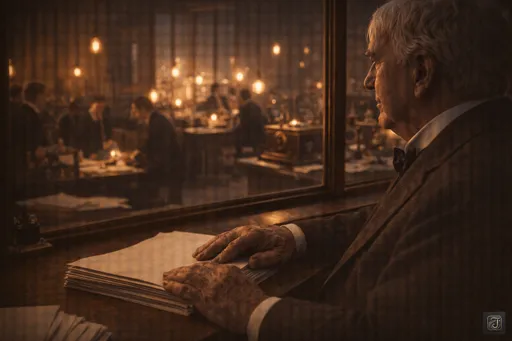
In the laboratory, no one speaks until dawn anymore.
Discussions rush toward conclusions,
and failures are no longer recorded.
Efficiency rules everything.
Edison considers this natural.
He could not have come this far
If he thought otherwise.
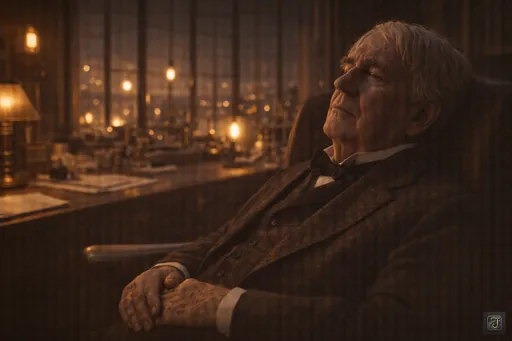
He is not alone.
But there is no resonance.
People surround him.
Ideas do not.
The night quietly deepens.
He goes to sleep without turning off the light.
There is no need to return to darkness.
That light
is proof of his victory.
Whether it will illuminate the future
is not his concern.
He will keep winning today.
That is enough.
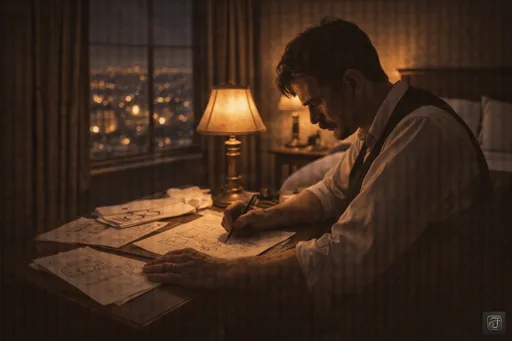
Far away, another night.
In a hotel room, a man sits alone, drawing lines on scraps of paper.
Though they lived in the same era
and spoke of the same light,
the two men never saw the same night.
The night of the man who won
was bright and quiet.
And that very quietness
was the price of his success.
Chapter 11: Solitude — In a Hotel Room
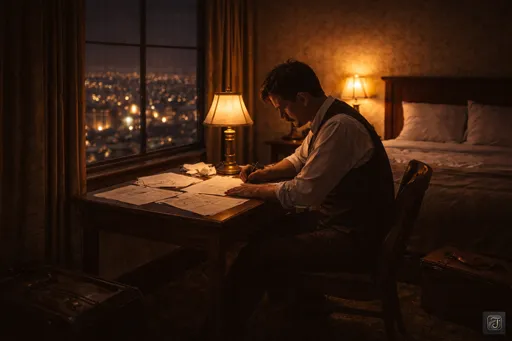
The room was small.
Not luxurious.
But clean.
An old hotel in New York.
A single room meant for long-term guests.
From the window, the lights of the city could be seen.
Countless points of light,
unceasingly repainting the night.
All of it rested upon his theories.
And no one knew it.
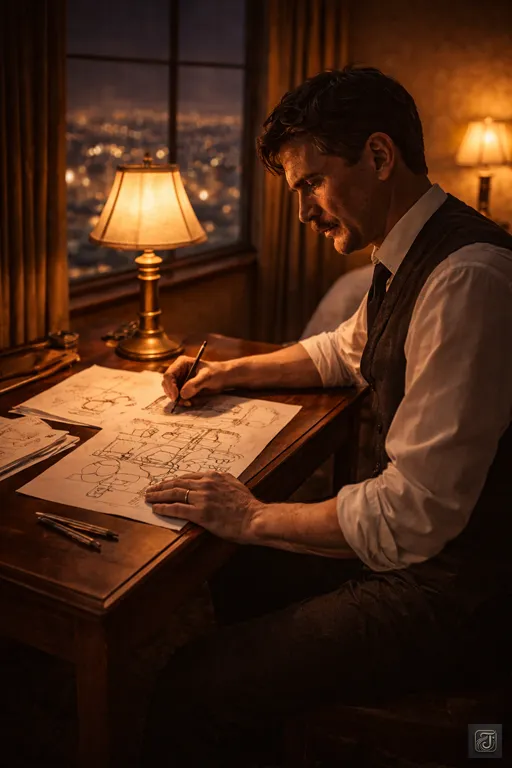
Nikola Tesla sat at the desk.
His posture was straight, his appearance immaculate.
Poverty had not stripped him of his dignity.
On the desk lay a few sheets of paper and a sharpened pencil.
Unfinished diagrams.
Ideas no one would read.
Wireless transmission.
Resonance of the Earth.
The liberation of energy.
The world should already have been moving on to its next stage.
Yet the future in his mind had once again raced too far ahead of the world itself.
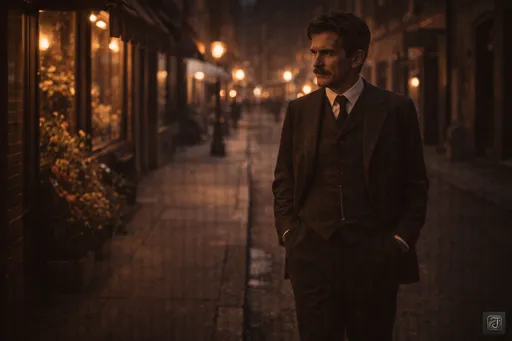
During the day, he spoke to no one.
The telephone never rang.
No one came to visit.
He had long since handed out all his business cards.
At night, he went out for a walk.
The same route.
The same hour.
The same storefronts.
He stopped after three steps,
then walked again.
Order calmed him.
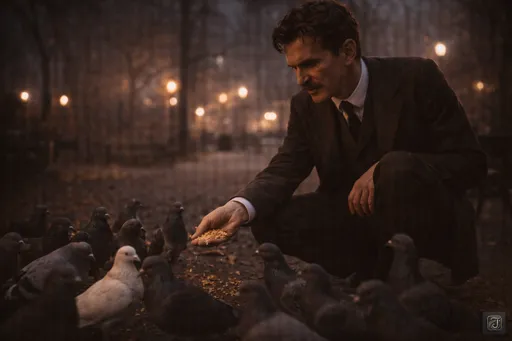
In a corner of the park, pigeons gather.
He sets down feed.
He looks at each bird individually, never confusing one for another.
“You’re doing well today,” he says.
A voice no one hears.
The pigeons do not betray him.
They do not ask to be understood.
They do not demand money.
They simply exist.
One day, he takes a single pigeon into his arms.
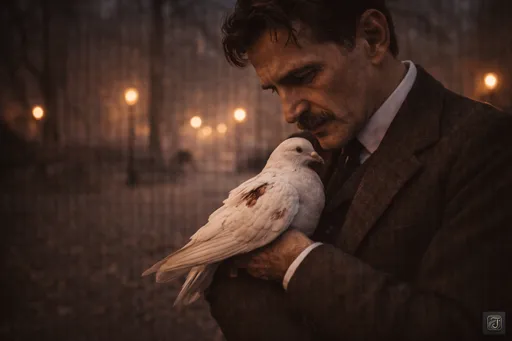
White feathers.
An injured wing.
A faint heartbeat.
Looking into its eyes, he thinks:
To be understood is not always happiness.
There are things that can be protected
only because they are not understood.
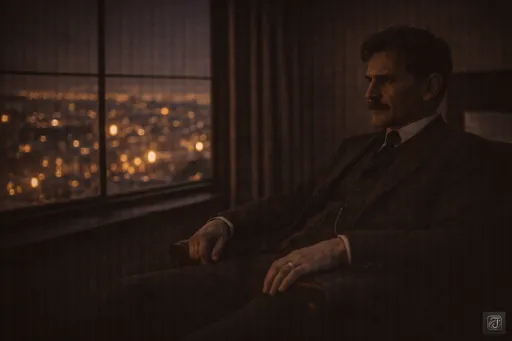
When he returns to his room, he does not turn on the light.
The glow from outside the window is enough.
Electricity no longer carries fear.
It is safe,
quiet,
and everywhere.
That ordinariness—
that unquestioned presence—
was his victory.
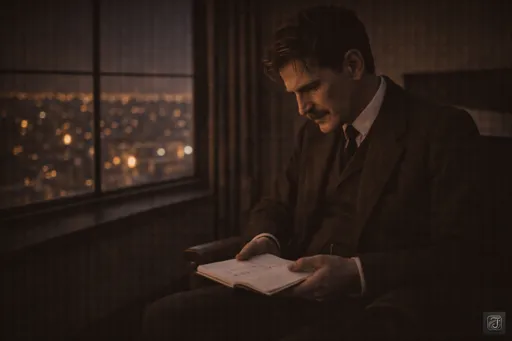
In the middle of the night, he closes his notebook.
He does not blame himself for what remains unfinished.
Precisely because it is unfinished,
the hope remains in the future—
that someday, someone else will complete it.
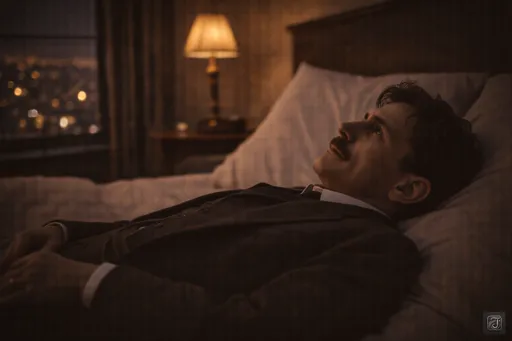
He lies on the bed and stares at the ceiling.
He remembers the night he watched the lightning when he was young.
His mother’s hands.
The rotating magnetic field.
The first light.
Life never betrayed him—not once.
It only asked him to choose solitude.
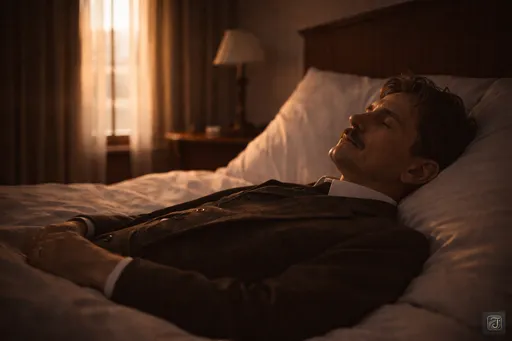
Morning comes quietly.
A pale light slips through the gap in the curtains.
He watches it, then closes his eyes.
“The world is already bright enough—
even without me.”
He accepts that truth calmly.
Chapter 12: Death and Silence
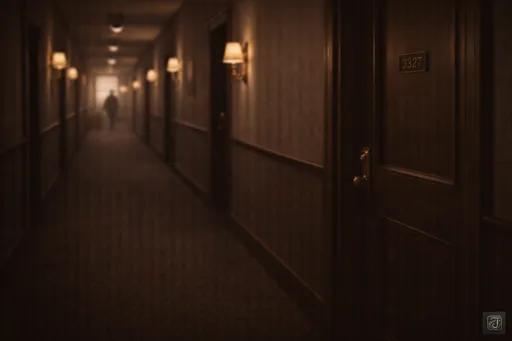
Morning came as it always did.
Footsteps echoed down the hotel corridor.
The faint rustle of newspapers being delivered.
The distant murmur of the city waking.
But one room alone remained silent.
A knock is meant to wait for an answer.
But this day was different.
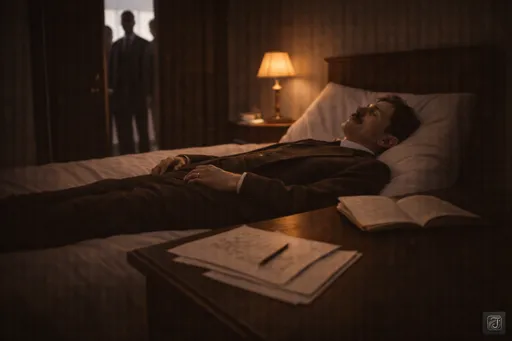
The door was opened, and the air shifted.
And no one spoke.
Nikola Tesla lay quietly on the bed.
There was no agony.
No sign of struggle.
Only the absence of breath.
On the desk lay neatly arranged papers.
Half-drawn diagrams.
A book left unfinished.
A future left incomplete,
abandoned as it was.
In the midst of war.
The world was busy with other deaths.
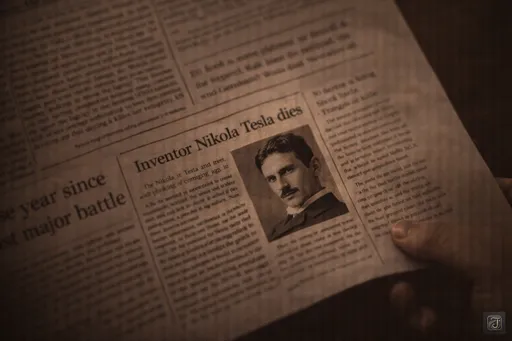
The newspapers ran a small article.
— “Inventor Nikola Tesla Dies”
The title was plain.
The achievements, overly condensed.
Father of electricity.
Eccentric.
An odd scientist.
None of it was wrong.
Yet none of it was enough.
What he left to humanity—
achievements that could never have existed without him—
were treated as though they had belonged to no one from the start.
In that article,
The light he gave the world was never spoken of alongside his name.
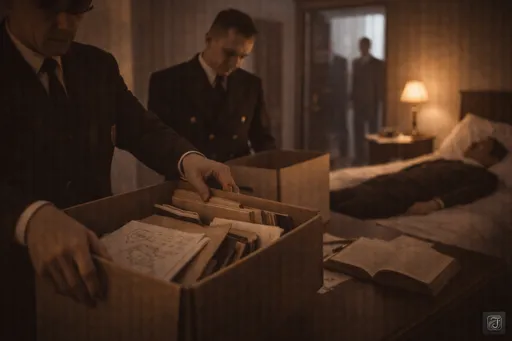
After his death, government officials entered the room.
They examined the papers and packed them into boxes.
“Anything dangerous?”
Someone asked.
“A few things we don’t understand.”
That was enough.
The documents were carried away.
No explanations were given.
Silence became official.
Even so, the world did not stop.
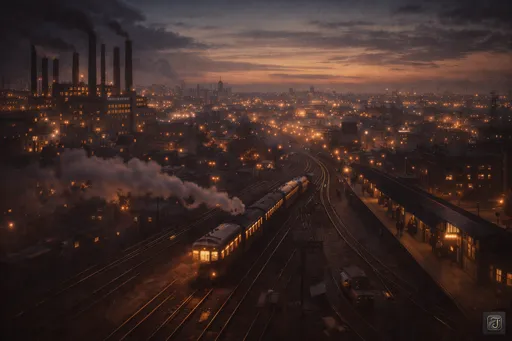
Trains kept running, factories kept moving, and the city lights did not go out.
Alternating current flowed as it always had.
No one flipped a switch because of his death.
And that, precisely, was the world he had wanted.
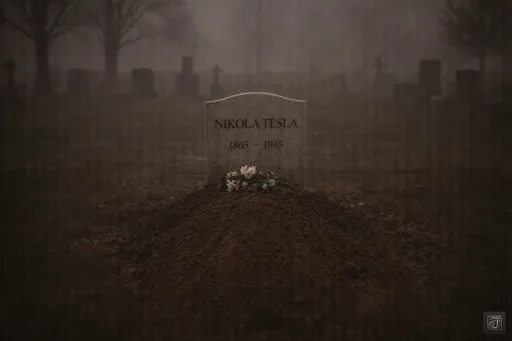
A few days later, he was buried quietly.
There was no crowd.
No speeches.
No statue—at least, not yet.
There was only earth, a name, and a brief silence.
People fear what they do not understand,
and in time, they forget what they once feared.
But forgetting is not the same as erasure.
Even if his name fades, his work remains.
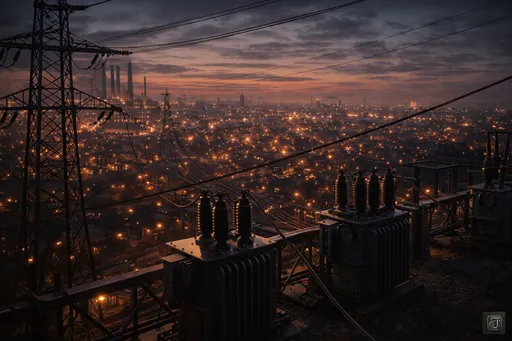
Power lines.
Transformers.
Countless lights illuminating the night.
They do not call his name.
They offer no thanks.
They simply work—precisely.
Ordinary daily life itself became his final resting place.
The world offers him no words in return.
And yet, the legacy he left to the modern age
continues to live on, even now,
within the quiet glow of everyday light—
as an unremarkable, enduring normality.
Epilogue: The Light, One Hundred Years Later
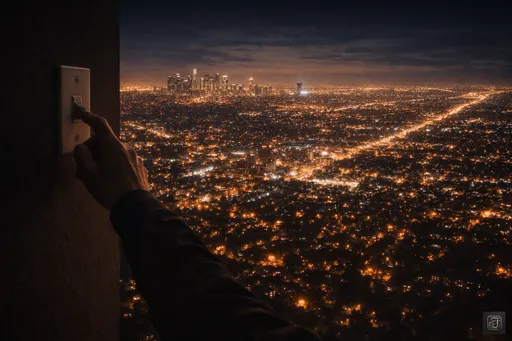
Night is no longer dark.
Cities rise from the ground toward the sky,
and light no longer traces roads,
but the horizon itself.
Someone flips a switch.
Without thinking.
Without questioning.
Lights turn on.
Machines begin to move.
The world goes on.
Power lines stretch across the land.
Transformers hum quietly.
Electricity comes from somewhere far away.
Where it was born,
who created it—
No one cares anymore.
And that is fine.
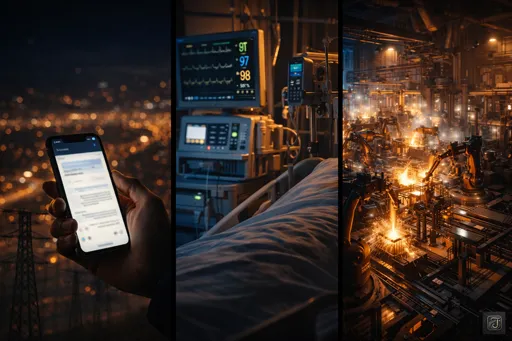
Smartphone screens glow.
Hospital machines measure life.
Factories run through the night without stopping.
Fire is no longer used.
There is no fear.
Electricity has become nothing more than the ordinary.
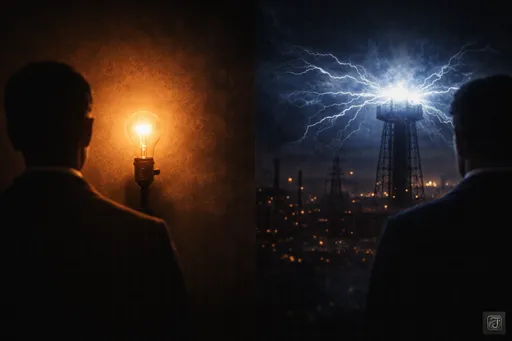
A hundred years ago, humanity was forced to choose.
Controlled light,
or liberated light.
Safety,
or the future.
Today, no one remembers that question.
And yet the answer is spread across the world.
As an invisible flow.
As an unquestioned system.
As a victory without a name.
Few people know his name.
But within his ideas, the world still lives.
Because it was never completed,
The hope remains that one day, someone else will complete it.
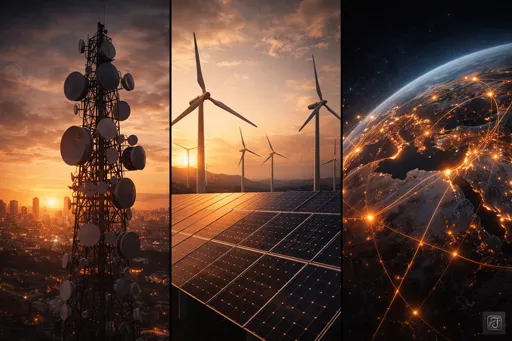
Wireless communication.
Renewable energy.
Power transmission on a planetary scale.
The lines he once drew are still extending, even now.
History records the names of the victors.
Civilization leaves behind only the systems.
And those systems continue, quietly, to change the world.
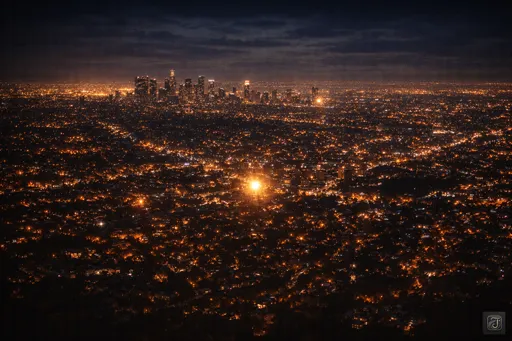
Within the nightscape, a single light flickers.
It belongs to no one.
And yet, it is a light that someone once saw first.
A hundred years later, the world lives inside that light—
without noticing,
without questioning.
The End
Author’s Afterword
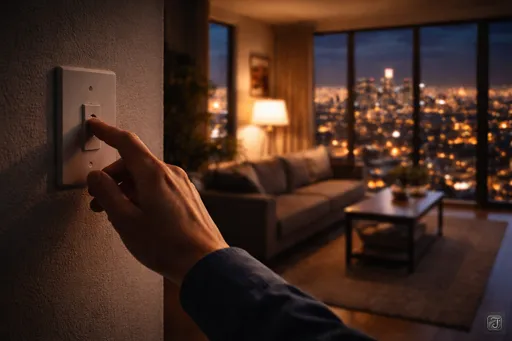
We live inside electricity every day.
At the press of a switch, lights come on.
Even at night, cities remain bright, and we rarely imagine electricity ever stopping.
It has become too ordinary.
And yet, we barely know the name of the person who made that “ordinary” possible.
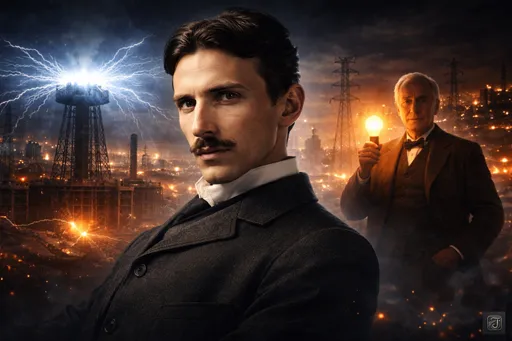
Nikola Tesla.
He was the man who gave form to the very foundations of modern civilization.
Alternating current.
Power transmission.
Voltage transformation.
Without these, the world as we know it could not exist.
And yet, he was pushed to the margins of history, while much of the fame came to be told as the story of Thomas Edison.
This is not to deny Edison.
He, too, was a man who moved his era forward.
But it was Tesla who released the mechanism of light into the world.
That much, I could not leave unwritten.
That is why I wrote this story.
Not to condemn anyone.
Not to turn a man into a mythic hero.
But simply to cast a rightful light on one human being who stood behind what we now call “ordinary.”
If only within the pages of this story.
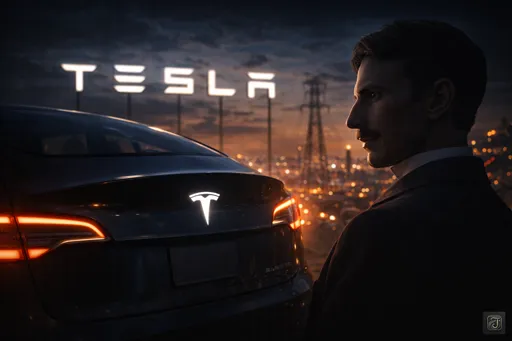
Interestingly, a modern company chose to bear the name “Tesla.”
Not “Edison,” but “Tesla.”
I don’t believe that choice was accidental.
The power to change the future does not reside in what is already complete,
but in ideas that remain unfinished.
Because they are unfinished, someone else can take them up and carry them forward.
That chain of continuation—
That was what Tesla believed in.
If, after finishing this story, you look at the lights of the night
and for even a brief moment think of him—
Then I believe this story has already served its purpose.
This work is based on historical facts, but the psychological portrayals and scene compositions have been restructured for narrative purposes.
Comment